Nintendo's AI Gamble: How the Switch 2 Bets on DLSS, Not Raw Power
The Nintendo Switch 2 doesn't out-muscle the PS5 — it out-thinks it. How Nvidia's DLSS upscaling lets a handheld punch far above its teraflops.
By Shujaat Ahmed · · · 6 min read
The Bet: Efficiency Over Brute Force
Nintendo has never won the spec war, and with the Switch 2 it isn't trying to. The console that launched on June 5, 2025 for $449.99 is not built to out-muscle a PlayStation 5 or Xbox Series X. It's built to render less and show more — leaning on machine-learning upscaling to reconstruct resolution and frame rate the silicon would never brute-force on its own. That is the real story of this hardware, and it's a smarter bet than the raw numbers suggest.
The thesis is simple: while Sony and Microsoft chase teraflops, Nintendo is chasing efficiency. And the partner it hired to get there is the one company that has spent the better part of a decade turning AI upscaling into a competitive advantage — Nvidia.
What's Actually Inside
Nintendo and Nvidia were coy for months, but the confirmed spec sheet is now clear:
- Processor: a custom Nvidia T239 chip on the Ampere architecture
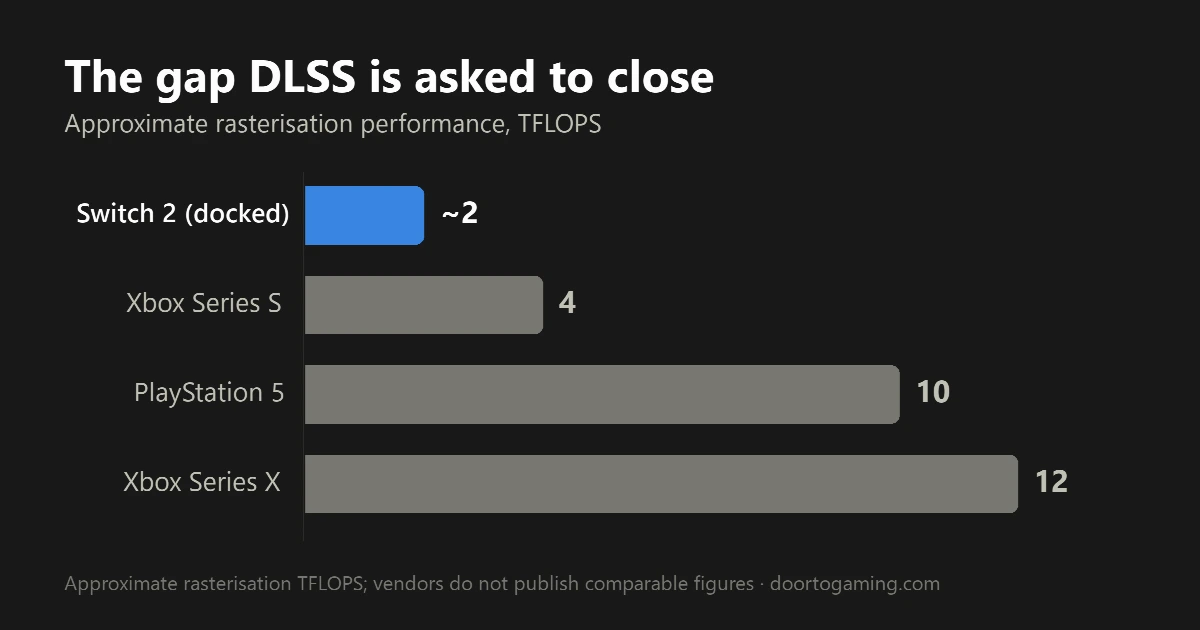
- GPU: 1,536 CUDA cores plus dedicated RT (ray-tracing) cores and Tensor cores, delivering roughly 3.1 teraflops docked and about 1.7 teraflops in handheld mode
- CPU: an 8-core Arm Cortex-A78C, with six cores freed up for games
- Memory: 12GB of LPDDR5X, roughly 9GB of it available to games
- Display: a 7.9-inch 1080p LCD with HDR and variable refresh up to 120Hz
- Docked output: up to 4K on a compatible TV (capped at 60fps at 4K, or up to 120fps at lower resolutions)
None of that is exotic by 2025 PC standards — the GPU sits in the neighborhood of a mobile RTX 2050. What matters is the Tensor cores. That single design choice is why the Switch 2 exists in the shape it does.
DLSS: The Whole Point of Going Nvidia
DLSS — Deep Learning Super Sampling — is Nvidia's headline trick. Instead of rendering at full output resolution, the GPU renders a much smaller internal image and uses a neural network, running on those Tensor cores, to reconstruct a sharper high-resolution frame in real time. The cost in raw compute is a fraction of native rendering; the perceptual result can be close to indistinguishable.
On a power- and heat-constrained handheld, that's not a luxury — it's the enabling technology. It's how the Switch 2 can target 4K on a TV, or a stable 1080p at high frame rates, without a desktop GPU's power budget.
The clearest real-world example is Cyberpunk 2077, confirmed as the first Switch 2 title to use DLSS. Docked, it outputs at 1080p with dynamic resolution scaling and DLSS doing the reconstruction, offering a 30fps quality mode and a 40fps performance mode — and it even layers in ray-traced reflections. A 2020 open-world PC benchmark running on a tablet you can slide into a bag is the entire argument for this architecture.
The Switch 2 isn't powerful. It's clever. DLSS is the difference between those two words.
Ray tracing is supported by the RT cores, but at this power envelope expect it to stay a garnish rather than a main course — reflections here and there, not fully path-traced scenes.
How It Stacks Up Against PS5 and Xbox
On paper it isn't close. The PS5 pushes around 10.3 teraflops and the Xbox Series X roughly 12 — three to four times the Switch 2's docked output. If teraflops were destiny, this would be a blowout.
But teraflops stopped being destiny the moment AI upscaling got good. Sony itself validated the approach when the PS5 Pro shipped with PSSR, its own machine-learning upscaler — the same fundamental idea Nvidia pioneered. The whole industry is converging on render less, reconstruct more.
Nintendo's twist is doing this in a device that also fits in your hands and sips power. The real question was never Switch 2 versus Series X on a bench — it's whether a hybrid handheld can run current-generation third-party games well enough that publishers keep shipping them. So far, with Cyberpunk and a growing port list, the answer is trending yes.
The Rest of the Package
The hardware around the chip got a genuine upgrade too. The redesigned Joy-Con 2 controllers now attach magnetically and release with a button on the back — no more fragile rail. Each one doubles as an optical mouse: set it on a table and it tracks like a PC mouse, and both can be used at once. A new C button launches GameChat, Nintendo's built-in voice, screen-share, and video chat. HD rumble returns with more localized, dynamic haptics.
It's an iterative, sensible spread — familiar enough not to alienate the enormous existing Switch audience, new enough to justify the box.
The Real Gamble Is at Checkout
The genuinely new risk isn't in the silicon — it's in how Nintendo wants you to buy games. Two shifts matter.
Game-Key Cards. Some Switch 2 "physical" releases ship on a cartridge that holds no game data — only a license key. You insert the card, download the game, and must keep the card inserted to play. It's cheaper for publishers and still resellable, unlike a pure download, but it collapses much of the point of owning physical.
A digital-versus-physical price split. Starting in May 2026, Nintendo's own Switch 2-exclusive titles carry two prices: $59.99 digital and $69.99 on a cartridge — a $10 premium for physical. Nintendo frames it as offering digital cheaper rather than raising physical prices, citing the different costs of producing and distributing each format.
Whether players read that as fair, or as a nudge toward a locker of un-resellable downloads, is the open question. It's a quieter gamble than the chip, but arguably the more consequential one.
What It Means for Players
Strip away the marketing and the Switch 2 is a coherent, honest machine. It won't win a resolution shootout, and it isn't meant to. It's betting — reasonably — that a well-executed AI upscaler, a great screen, and clever controllers beat raw horsepower you can't hold.
- If you want the best-looking version of a game, this isn't it — a PC or PS5 Pro will always render more pixels natively.
- If you want current-gen third-party games in a handheld, nothing else does it quite like this.
- Watch the storefront, not the spec sheet. The upscaling is genuinely good; the pricing and Game-Key Card fine print are where you'll actually feel Nintendo's strategy.
Nintendo's AI gamble is real, but it isn't reckless. It's the company reading where rendering is headed and building the smallest, cheapest box that can credibly go there.
Tags: nintendo switch 2 switch 2 architecture yoshi and the mysterious book nvidia t239 dlss gaming ai upscaling handheld gaming 2026 gaming hardware news ray reconstruction magnetic haptics joy-con 2 console specs gaming tech blog nintendo leaks future of gaming software defined hardware gaming price trends digital vs physical games nvidia ampere tensor cores
Written by Shujaat Ahmed
Shujaat Ahmed is the founder and editor of Door To Gaming. A lifelong gamer, he writes about the games, hardware, and industry news he cannot stop thinking about.