The $80 Game Isn't a New Standard. Take-Two Priced NBA 2K27 at $70.
GTA 6 costs $80, NBA 2K27 costs $70, and both come from the same publisher in the same year. Zelnick says pricing hasn't kept pace with inflation and that he could have charged more. The real shift isn't the base price — it's the $100 tier buyers are choosing.
By Shujaat Ahmed · · 6 min read
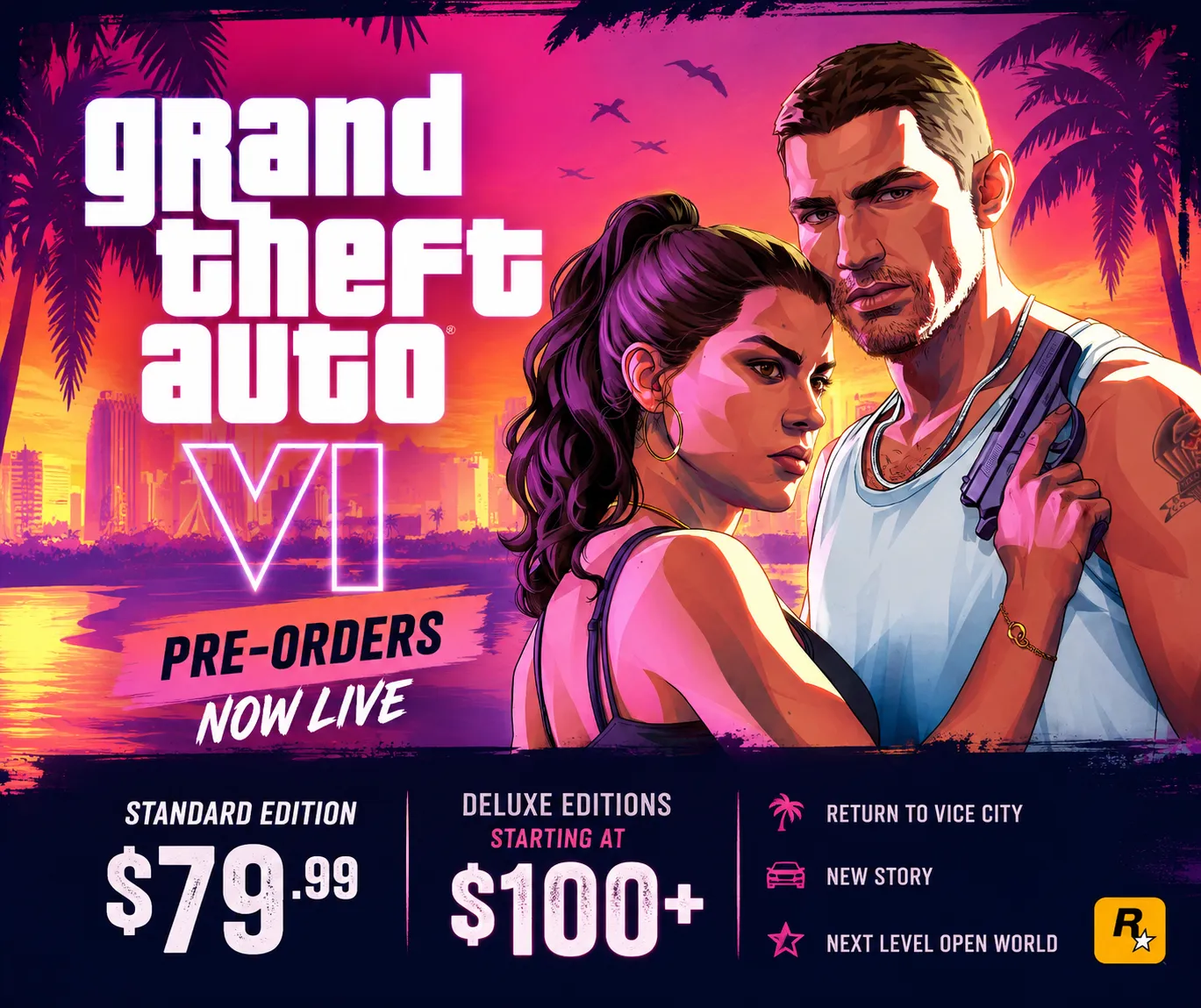
When Grand Theft Auto VI pre-orders opened on June 25 at $79.99, the reaction wrote itself: $80 is the new standard, physical media is dead, and game ownership died with it.
Two of those three claims do not survive checking. The third is true in a narrower and more interesting way than the headlines suggested.
The $80 "standard" that isn't one
Here is the fact that dismantles the framing. In the same period Take-Two priced Grand Theft Auto VI at $80, it priced NBA 2K27 at $70.
Same publisher. Same fiscal year. Ten dollars apart.
If $80 were an industry-wide reset driven by production costs — the explanation offered almost everywhere — it would not stop at the door of Take-Two's other tentpole franchise. Strauss Zelnick was asked directly about the gap and framed it as a title-specific decision rather than a new baseline.
His stated reasoning cuts against the cost narrative even harder:
"The real cost of a triple-A videogame is a whole lot lower today than it was 20 years ago. Pricing has not kept pace with inflation."
And on GTA 6 specifically: "given the hype around this title, I think we could have made any number of other pricing choices."
That is not a publisher passing on unavoidable costs. That is a publisher saying the quiet part clearly: this title can carry $80 because of what it is, and a different title carries $70 because of what it is. The mechanism is demand, not budgets.
Where the money actually comes from
Fixating on the standard edition misses the tier that matters. The Ultimate Edition is $99.99, and Zelnick has said pre-orders "skew more to the premium edition."
Take-Two released no hard split, and Zelnick attributed the skew to who buys first — "the most avid consumers are the ones who are pre-ordering now" — suggesting the ratio may even out as casual buyers arrive closer to launch. Fair caveat, and worth holding onto.
But the structural point stands. The interesting pricing move of this generation is not the standard edition creeping from $70 to $80. It is the $100 tier that did not exist as a default option a decade ago, now absorbing the most enthusiastic segment of the audience. A $10 rise on the base price is visible and generates headlines. A $20 premium tier that a large share of buyers self-select into is where the revenue arithmetic actually changes.
This is textbook price discrimination, executed well. Zelnick's framing — that satisfaction lives at "the intersection of the thing itself and what you paid for it" — is a description of exactly that: let each buyer sort themselves into the tier they feel good about.
The disc question, handled honestly
Now the part that is genuinely true. At launch, the physical GTA 6 product is a code in a box. Retail listings are not for a disc. If you buy the boxed version on November 19, you are buying packaging around a digital licence.
You will also see it reported that a real disc is coming later. Before repeating that, look at where it comes from.
The claim traces to a screenshot of a Rockstar Support reply saying a physical disc copy would arrive in "the following months," surfaced via Polish outlet PPE.pl, with leaker Graczdari suggesting December 2026. PC Guide, reporting it, flagged that the screenshot contains a grammatical error and advised treating it with caution.
That is the entire evidentiary basis. Not a press release, not a store listing, not a Rockstar statement — a support-chat screenshot with a typo in it, plus a leaker.
It may well be accurate; support agents often know shipping plans. But "Rockstar confirms disc version coming" is a considerably stronger sentence than the sourcing supports, and it has been repeated as though a disc release were scheduled.
What is verified: no disc at launch. What is not: anything about a disc afterwards.
What actually changed about ownership
The ownership argument is where most coverage overreaches, so it is worth being precise.
A code in a box removes the resale, lending and trade-in rights that a disc carried. That is a real loss, and for GTA 6 specifically it is the first time a flagship release of this scale has made it the default at launch. Anyone who built their buying habits around trading in finished games has lost that option here.
What it does not do is make this game less "owned" than the digital copy the overwhelming majority of players were already going to buy. Digital was the majority route long before GTA 6. The code-in-box is not a new restriction so much as the retail shelf finally admitting what the market had already chosen — and charging for cardboard to do it.
The durable question is the one the California preservation fight is actually about: what happens to a purchase when the servers or the storefront go away. A disc did not protect you from that either, for anything requiring activation or online components. The code-in-box just removes the last comforting illusion that it did.
The number behind the confidence
None of this pricing happens in a vacuum. Take-Two has guided fiscal 2027 net bookings to $8.0–$8.2 billion, against $6.72 billion in fiscal 2026, and Zelnick has named the November 19 launch as the engine behind that forecast.
For context on why they feel able to set the price where they like: GTA V sold 230 million units across three console generations. A publisher with that track record, guiding to a record year on the back of one release, is not pricing defensively.
What to take from it
Do not read $80 as the new floor for everything. It is not, and the publisher that set it also shipped a $70 game the same year while explicitly declining to call $80 a standard.
Read it instead as the point where per-title pricing arrived openly. Publishers have always known some games can carry more than others. What changed is that they now act on it in public, tier by tier, title by title — and the $100 edition, not the $80 one, is where that strategy actually pays.
The disc going away matters. But it is the smaller story, and the one most likely to be reported with more certainty than anyone currently has.
Tags: $80 video games death of physical media digital only games GTA 6 price gaming industry trends
Written by Shujaat Ahmed
Shujaat Ahmed is the founder and editor of Door To Gaming. A lifelong gamer, he writes about the games, hardware, and industry news he cannot stop thinking about.