The Game Pass Break-Even Everyone Computes Is Half the Real One
Subscription divided by $70 a game gives you a break-even of about four games a year, and it is wrong — almost nothing in these catalogues is a game you would have bought on release day. Divide by what you would actually have paid and the number roughly doubles. Plus two things the platforms say on their own pages: PlayStation Plus has no day-one tier at any price, and Game Pass Ultimate excludes Call of Duty from its day-one promise.
By Shujaat Ahmed · · 8 min read
The maths looks simple enough that nobody checks it. Game Pass Ultimate runs about $276 a year. A new game is $70. So the subscription pays for itself at four games a year, and if you play more than four games you are winning.
Every version of that sum has the same flaw, and it is not the numerator. It is the denominator. You are dividing by what a game costs on its release day, and almost nothing in these catalogues is a game you would have bought on its release day.
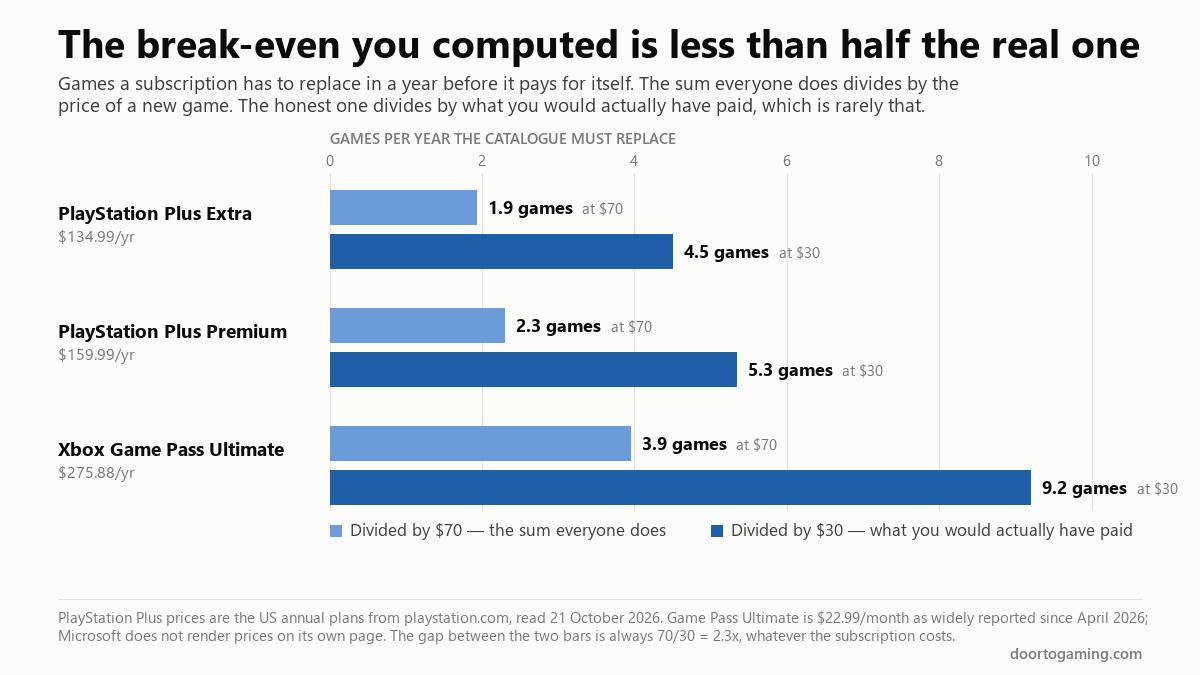
Do it with the number you would actually have spent and the break-even roughly doubles. On PlayStation Plus Extra it moves from under two games a year to four and a half. That is the difference between an easy yes and a genuinely close call.
First, what you are actually buying
Before the arithmetic, a correction that decides the question for a lot of people, and it comes straight from the platforms' own pages.
PlayStation Plus has no day-one tier. Not Extra, not Premium. Sony's own comparison lists what each tier adds: Extra adds the Game Catalog, "hundreds of games." Premium adds the Classics Catalog, game trials and cloud streaming. Neither adds new releases on launch day. If you subscribed expecting to play this autumn's big PlayStation release at no extra cost, that was never on offer at any price.
Game Pass does have a day-one tier, and it carves out the biggest game of the year. Xbox's own page is explicit about the ladder: Essential "does not include new release titles on day one," Premium gets new Xbox-published games within a year of launch, and Ultimate and PC Game Pass get "new games on day one." Then the footnote under that promise reads: "Select games. Excludes Call of Duty titles."
That exclusion is not a detail. Call of Duty is the largest annual release in the business and it was, for years, the single most-cited reason to pay for Ultimate rather than Premium. We covered the price cut that came with that change — Ultimate got cheaper, and this is part of what it got cheaper for.
So the honest description of what these services sell is a back catalogue, plus — on one platform, at the top tier, with exclusions — some new releases. Price it as a catalogue, because that is what it is.
The denominator problem
Here is the arithmetic, done both ways. PlayStation's prices are the annual plans from Sony's own storefront; Game Pass Ultimate is $22.99 a month as widely reported since April 2026, which Microsoft does not display on its own page.
Divide by $70, the price of a new game:
- PS Plus Extra, $134.99/yr — 1.9 games a year
- PS Plus Premium, $159.99/yr — 2.3 games a year
- Game Pass Ultimate, $275.88/yr — 3.9 games a year
Divide by $30, roughly what a year-old game costs in a sale:
- PS Plus Extra — 4.5 games a year
- PS Plus Premium — 5.3 games a year
- Game Pass Ultimate — 9.2 games a year
The second set is the one that describes your actual decision, because the alternative to subscribing was never "buy these same games at $70." It was "buy two of them in a sale eighteen months from now and never get round to the others."
Notice that the gap between the two columns is identical for all three services — 70 divided by 30, about 2.3 times. It has nothing to do with which subscription you are looking at or what it costs. It falls out of the denominator alone, which is the whole point: the thing that decides whether a subscription is worth it is not its price. It is your honest estimate of what you would otherwise have spent.
If you are the sort of person who buys three or four games a year at full price on release, divide by $70 and the subscriptions look excellent. If you are the far more common sort who waits for a sale, divide by $30 and most of them need you to genuinely play nine or ten catalogue games a year.
The thirty percent most people hand over for nothing
One number on Sony's page is worth more than any of the above, because it costs nothing to act on.
PS Plus billed monthly against the same tier billed annually:
- Essential — $10.99 × 12 = $131.88, against $79.99 a year. You pay 39% more for the privilege of paying monthly.
- Extra — $203.88 against $134.99. 34% more.
- Premium — $239.88 against $159.99. 33% more.
That is $52 to $80 a year, for nothing but the billing cycle. If you have been subscribed monthly for more than a few months, you have already decided you are keeping it, and the monthly plan is charging you a third extra for a flexibility you are not using.
The only good reasons to pay monthly are that you genuinely intend to cancel within a few months, or that the annual outlay is not affordable in one go. Both are real. Neither applies to most people paying monthly.
When a subscription genuinely wins
Three cases, and they are narrower than the marketing implies.
You play a lot of things briefly. The strongest argument for a catalogue is not value per game, it is permission to abandon one. Bouncing off a game after ninety minutes costs nothing, so you try things you would never have risked $70 on. That is a real benefit and it does not show up in any break-even sum.
You are buying a platform's first-party output on Xbox. Day one on Ultimate is genuinely day one for Xbox-published games, Call of Duty aside. If that is most of what you play, the sum works at $70 because you really would have paid $70.
You have a household. Shared plans and family accounts change the arithmetic more than any of the tier differences, and they are the one place the naive sum understates the value rather than overstating it.
When it does not
You are a one-or-two-games-a-year player. Buy the two games. You will own them, and you will spend less.
You mostly play one live-service game. Fortnite, a shooter, an MMO — the catalogue is irrelevant to you and you are paying for online access you may already have, or may not need at all on PC.
You buy in sales anyway. This is the big one, and it is the case the $70 denominator is designed to hide from you. A patient buyer's real spend on games is far below what the marketing assumes.
You care about keeping them. Nothing in a catalogue is yours, and catalogues rotate — games leave. That is a different argument from price, and we have written about where the legal ground on owning games is heading. Worth reading before you treat a subscription as a replacement for a library rather than a supplement to it.
So do the sum properly
Three numbers, two minutes.
- What did you actually spend on games last year? Not what you meant to spend. Check your purchase history — both storefronts will show you, and the figure is usually lower than people guess.
- How many of those were bought at full price on release? That tells you which denominator is yours, $70 or $30.
- Divide the annual subscription by that number, and ask honestly whether you will play that many catalogue games.
If the answer is yes, subscribe, and pay annually. If it is no, the games you want will be half price within a year regardless.
The comparison that matters was never between the two subscriptions. It is between a subscription and what you were otherwise going to do, and most people compare it against a version of themselves who buys far more games at far higher prices than they really do.
The short version
- The usual break-even divides by $70 and that is the wrong number. Catalogue games are not games you would have bought on release day. Divide by about $30 and the break-even roughly doubles — PS Plus Extra goes from 1.9 games a year to 4.5.
- The 2.3x gap is the same for every service because it is just 70 ÷ 30. What decides the answer is your spending, not the subscription's price.
- PlayStation Plus has no day-one tier at all. Extra and Premium are back catalogue; Sony's own page says so.
- Game Pass Ultimate's day-one promise excludes Call of Duty — stated in Microsoft's own footnote, and it was the main reason many people paid for Ultimate.
- Paying PS Plus monthly costs 33–39% more than annually — $52 to $80 a year for nothing but the billing cycle.
- Check your actual purchase history before deciding. Most people's real spend is well below the number the naive sum assumes.
Tags: Xbox Xbox Game Pass PlayStation 5 PlayStation Plus game subscriptions Game Pass Ultimate PS Plus Extra gaming value Call of Duty game prices subscription pricing buying games
Written by Shujaat Ahmed
Shujaat Ahmed is the founder and editor of Door To Gaming. A lifelong gamer, he writes about the games, hardware, and industry news he cannot stop thinking about.