Iris or OptiFine in 2026? OptiFine Hasn't Shipped Stable Since February
Every shader guide ends with "install it through Iris" and almost none explain why. The answer is one fact on OptiFine's own download page: its newest stable build is for Minecraft 1.21.11, dated February. Iris supports 26.3. What each one actually is, what you give up by switching, and the one case where OptiFine is still the right call.
By Shujaat Ahmed · · 6 min read
Every shader guide, including ours, ends with some version of "install it through Iris." Almost none of them explain what Iris is, or why it rather than OptiFine, which is the mod most people have heard of and many still have installed.
The honest answer in October 2026 is that the question mostly answers itself, and it does so on a single fact that takes thirty seconds to check on OptiFine's own website.
Which should you use?
Iris, unless you specifically need a Forge mod that will not run without OptiFine.
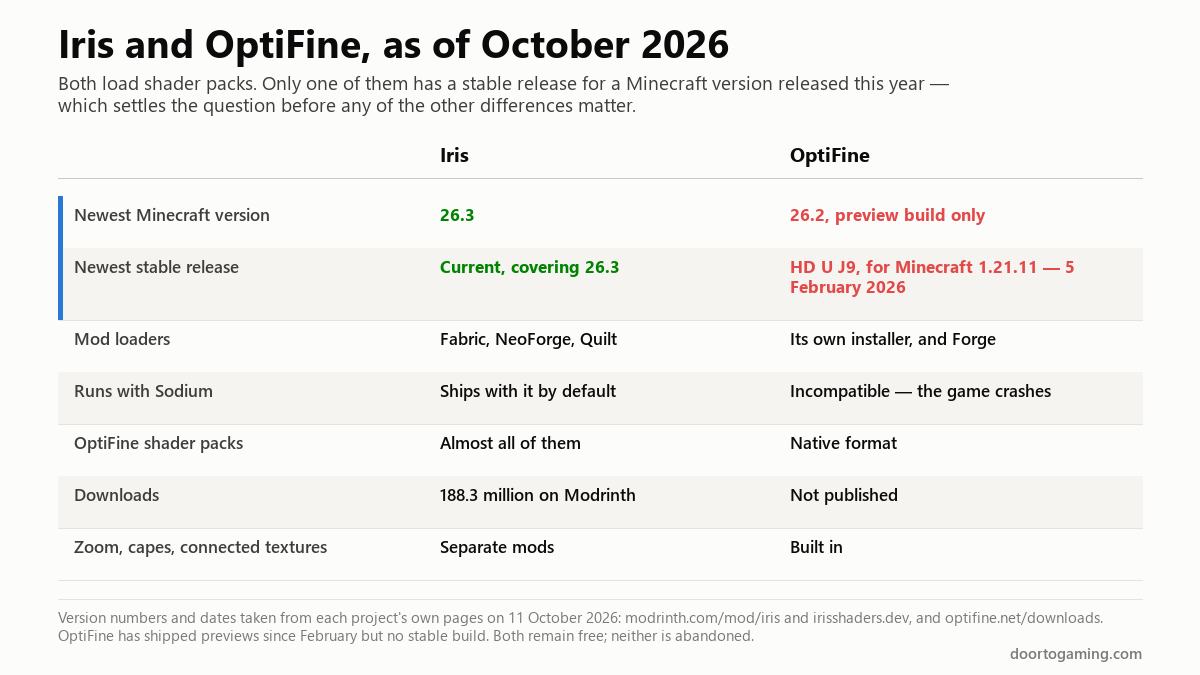
The deciding fact is not performance, or looks, or preference. It is that OptiFine's newest stable release is HD U J9, for Minecraft 1.21.11, dated 5 February 2026. Everything it has shipped since is a preview build, the most recent being HD U K2 pre1 for Minecraft 26.2 on 22 September.
If you are playing a current version of Minecraft, there is no stable OptiFine for it. That is the whole decision, and the rest of this page is detail.
What the two things actually are
They are not quite the same kind of software, which is where most of the confusion comes from.
OptiFine is a single large mod that replaces big parts of Minecraft's renderer and bundles a great many features together: shader support, but also zoom, capes, connected textures, dynamic lights, configurable animations and a long list of video settings. It installs through its own installer, and it has been the default answer since long before there was an alternative.
Iris is narrower. It is, in its own words, "a modern shader pack loader for Minecraft intended to be compatible with existing OptiFine shader packs." It loads shaders. It does not do capes or zoom. What it does do is ship alongside Sodium, the rendering optimisation mod — "Iris ships with Sodium for optimized rendering out of the box."
That bundling is the architectural point. Before Iris, Sodium and OptiFine were mutually exclusive, because both rewrite the same part of the game. You could have the faster renderer or you could have shaders, and you had to choose. Iris exists specifically to dissolve that choice.
They are still mutually exclusive with each other, incidentally, and not politely so. Iris's own documentation lists OptiFine under "Incompatible, and will crash the game." Do not install both and hope.
The compatibility question people actually worry about
The usual hesitation about switching is that your shader packs will stop working. They almost certainly will not.
Iris was built from the start to read OptiFine's shader format, and describes itself as "designed to extend the ability of shader packs, while remaining (mostly) compatible with Optifine packs." Its Modrinth page claims support for "almost all shaderpacks," with a short published list of exceptions.
In practice this is why a pack like SEUS Renewed, which has not shipped a release since February 2020, still loads on a 2026 version of Minecraft. It is not that the pack was updated. It is that Iris carries a translation layer for an API that stopped moving years ago.
The parenthetical "(mostly)" is doing real work and deserves respect — if you depend on one specific unusual pack, check the exception list before switching. But for the four packs that dominate every recommendation thread, this is a non-issue.
What you give up
This is the part the enthusiastic posts skip, so here it is plainly. Moving to Iris costs you the rest of OptiFine's feature list:
- Zoom, which an enormous number of players use constantly and miss immediately
- Capes, for anyone who bought one
- Connected textures, dynamic lights, custom entity models, and the deeper animation controls
All of these have Fabric equivalents — zoom in particular has several — but they are separate mods you have to find and install, rather than a single checkbox. If what you value about OptiFine is that it is one installer and then everything works, Iris genuinely is more fiddly on day one.
The other real exception is Forge. Iris targets Fabric, NeoForge and Quilt. If your modpack depends on a Forge-only mod with no modern equivalent, OptiFine may still be the practical choice, and you will be on an older Minecraft version anyway, which is exactly the situation where OptiFine's stable build is fine.
Is OptiFine finished?
No, and it would be unfair to say so. It is still being worked on — the 26.2 preview is three weeks old at the time of writing, which is not the signature of an abandoned project.
But a preview is not a stable release, and the gap matters if you are not comfortable running pre-release builds. Eight months without a stable build, while Minecraft shipped several versions, is the situation as it stands. It may be resolved next month.
The reasonable position is the one the numbers support: OptiFine is maintained, slowly, and Iris is maintained quickly. For a piece of software whose entire job is to keep working when Minecraft changes underneath it, speed is most of the value.
What to install, concretely
- Fabric, as your mod loader, unless a specific modpack demands otherwise.
- Iris, from Modrinth or the installer on its own site. Sodium comes with it.
- A shader pack, dropped into the
shaderpacksfolder — Complementary Reimagined if you want one answer. - A zoom mod, if you are coming from OptiFine. You will want it on the first day.
And before you decide your machine cannot handle shaders: the thing that governs your frame rate is the preset and the shadow map resolution inside it, not the loader and not the pack. Neither Iris nor OptiFine makes a 4096 shadow map cheap.
None of this applies to Bedrock Edition, which cannot load Java shader packs at all and has no equivalent of either mod.
The short version
- Use Iris, unless a Forge-only mod forces your hand.
- The deciding fact: OptiFine's newest stable build is HD U J9 for Minecraft 1.21.11, from 5 February 2026. Iris supports 26.3. On a current Minecraft version there is no stable OptiFine to install.
- They are different kinds of thing. OptiFine is one large mod bundling shaders with zoom, capes and connected textures. Iris only loads shaders, and ships with Sodium for the rendering speed.
- Your shader packs will still work. Iris reads OptiFine's format and supports "almost all" packs — which is why a pack frozen in 2020 still runs today.
- You will lose zoom, capes and connected textures. All have Fabric replacements, but they are separate installs rather than one checkbox.
- Never install both. Iris lists OptiFine as incompatible, and the game crashes.
Tags: Minecraft shaders Complementary Reimagined Minecraft Java Iris shaders OptiFine Sodium Minecraft mods Fabric shader loader Minecraft performance NeoForge Minecraft 2026
Written by Shujaat Ahmed
Shujaat Ahmed is the founder and editor of Door To Gaming. A lifelong gamer, he writes about the games, hardware, and industry news he cannot stop thinking about.