Cheap Game Keys: The Discount Usually Beats the Risk. Here Is When It Does Not
WARDOGS buyers lost the game from their Steam libraries this month, weeks after their keys worked. A key from G2A or Eneba can be switched off after you have played it. The arithmetic says the gamble usually pays anyway — a discount stays cheaper until the chance of revocation equals it. The question is which listings carry the risk, and they are recognisable.
By Shujaat Ahmed · · 9 min read
On October 19, a WARDOGS player opened Steam and found the game gone from their library. They had bought the key nine days earlier from a key site and had been playing it since. Other buyers reported the same thing that week, from several different stores, after two or three weeks of play.
So: are cheap keys from G2A, Eneba and sites like them safe? Usually, in the narrow sense that most of them keep working — and when one does not, you lose less than you saved. The arithmetic below shows why. What the arithmetic cannot show is where the key came from, and that is the whole question. A cheap key is safe or unsafe because of its source, and there are a few signs that tell you which kind you are looking at.
What happened to WARDOGS buyers
Guided.news reported on October 20 that Steam had told several players their product key had been revoked. One Reddit user bought from Loaded on October 10 and lost the game on October 19. Others complained on Instant Gaming's product page, and a GAMIVO buyer said Steam cited a payment issue.
As of that report, neither the developer nor the retailers had explained why. Players suspect keys bought with stolen cards, but that is a guess. Keys can also be removed when a test period ends or a purchase is refunded. We will not pretend to know which applies here. What the case shows clearly is the pattern every buyer should know: the key worked, the game was played for weeks, and then it vanished.
Why a working key can disappear weeks later
Steam keys are not like a disc. The publisher can switch one off after it has been used. Valve's own rules for developers, on its Steamworks key documentation, allow a key to be banned when it was "stolen or purchased fraudulently," and say just as plainly: "You should never ban or disable Steam keys that have been legitimately sold to customers."
That second sentence is the protection you get from buying a key from a real store. It is also the protection you lose when the key was not legitimately sold to anyone — including the person who resold it to you.
The usual sequence looks like this:
- Someone buys keys with a stolen card. They buy from the developer's own store or a retailer that sells keys directly.
- They resell the keys on a marketplace, below the official price, and get paid quickly.
- The real cardholder sees the charge and disputes it. Card disputes take time, which is why revocations land days or weeks after the sale, not at the moment of purchase.
- The developer loses the sale and pays a dispute fee on top, then revokes the keys tied to the fraudulent orders. Every buyer down the chain loses the game.
This is not hypothetical. Factorio's developer, Wube Software, found that over 300 of its keys had been bought with stolen cards in 2016, shortly after the game came to Steam, and revoked them. In 2019 G2A offered to pay developers ten times their chargeback losses if fraud through its marketplace could be shown. G2A's own investigation then found that 198 of those keys had been sold on its marketplace between March and June 2016, and in May 2020 it paid Wube $39,600. That figure is 198 keys × a $20 chargeback fee × 10.
Stolen cards are not the only leak. Valve's same documentation warns developers that "fraudsters impersonating journalists or storefronts" request free keys, and then resell "those keys for profit." And in August 2026, tinyBuild revoked 649 keys for ReStory: Chill Electronics Repairs, "most of which were confirmed to have been sold on dubious key reselling sites," and said it had identified the partner the keys leaked from. Its CEO, Alex Nichiporchik, told players: "Just buy games on Steam. If a deal seems too good to be true, it probably is."
The arithmetic: why the risk is usually small for you
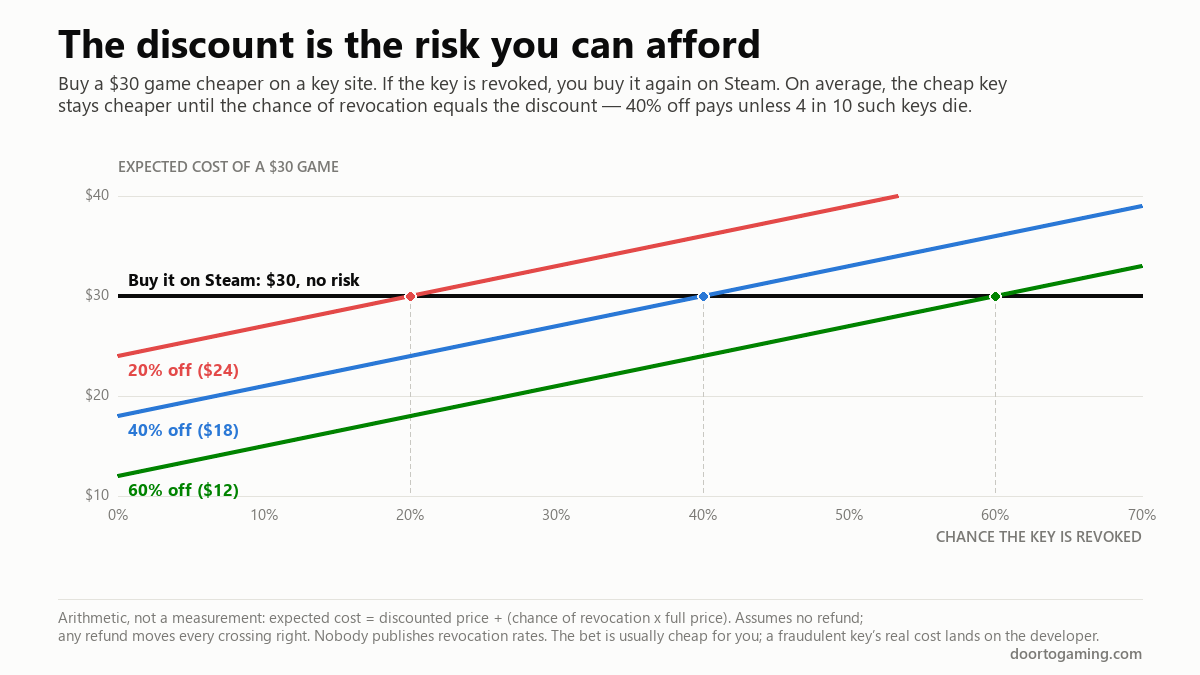
Here is the part the warnings leave out. Suppose a game is $30 on Steam, and a key site sells it at a discount. If the key gets revoked, you buy the game again on Steam at full price.
Your expected cost is the cheap price plus the chance of revocation times $30. Work through it and something tidy falls out: the cheap key stays cheaper on average until the chance of revocation equals the discount. At 40% off, the key would have to fail four times in ten before you lost money on average. At 20% off, two times in ten.
Nobody publishes revocation rates, so we cannot tell you the real chance for any listing. But it would take a very bad seller for four in ten keys to die. On pure money, for you, the bet usually pays. And if the marketplace refunds a revoked key, it pays even more often.
That is not the end of the calculation, for two reasons.
First, the risk is not spread evenly. Most keys on these sites come from somewhere ordinary: bundles, old promotions, retail stock. A few come from fraud. The fraudulent ones cluster in specific places, and you can often see them coming — see the next section.
Second, when a key is fraudulent, you are not the one who pays most. You lose a game you may be able to get refunded. The developer has already lost the sale, paid a fee on top, and given away a copy of their game. For a big publisher that is noise. For a small studio selling a few thousand copies, it is real money: RimWorld's developer stopped selling Steam keys from his own site after, in PC Gamer's headline words, "getting hammered by fraudsters."
The signs a cheap key is the risky kind
None of these prove a key is bad. Together they tell you which listings carry most of the risk.
A new game at a deep discount. Legitimate cheap keys mostly come from bundles, sales and old stock — none of which exist for a game that came out last month. A key 40% under the launch price in the first weeks has very few honest ways to exist. Both confirmed cases above fit: Factorio's keys were stolen in the months after its Steam launch, and ReStory's were revoked around its release.
A smaller game rather than a giant one. Fraud follows whatever is easy to buy in bulk and quick to sell. A new indie title, sold as keys on its developer's own site, is a softer target than a AAA game sold through big retailers.
A marketplace listing rather than a store. This is the distinction that matters most and gets blurred most often. Some sites — Humble, Fanatical, Green Man Gaming, GOG — are stores. They get their keys from the publisher, and when they sell you one it has been legitimately sold. Marketplaces like G2A, Eneba and Kinguin let many independent sellers list keys; the site is the venue, not the source. Some marketplace sellers are reputable businesses. But the site cannot tell you, from the listing alone, where a given key came from.
A price below what any official store charges. If a key is cheaper than the game has ever been on Steam, in any sale, somebody along the chain did not pay full price for it. Sometimes that is a bundle. Sometimes it is not.
Before you buy, and if a key dies
Read the refund policy for one specific case: a key that was activated, played, and revoked weeks later. Not a key that fails on arrival — every site covers that. If you cannot find a clear answer for a revocation after activation, assume you are not covered.
Keep the order details and a screenshot of the activation. If the key is revoked, you will need to show when you bought it, from whom, and that it worked.
Go to the seller, not to Steam. Valve carries out a revocation; the publisher requests it. When tinyBuild revoked ReStory keys, Nichiporchik's advice to affected players was to contact the sites they bought from. Steam Support generally cannot help, because the decision to revoke belongs to the publisher.
If you want the cheap price without the question at all, wait for a Steam sale, or buy from one of the stores above. The savings are smaller. The key cannot be taken back.
The short version
- A Steam key can be revoked after you have played the game for weeks. Valve allows it for keys "stolen or purchased fraudulently" and forbids it for keys "legitimately sold."
- WARDOGS buyers lost games this month after 9 days to 3 weeks. The cause has not been explained.
- The money maths usually favours the buyer: a discounted key stays cheaper on average until the chance of revocation equals the discount — 40% off pays unless four in ten such keys die.
- The real cost of a fraudulent key lands on the developer: a lost sale plus a chargeback fee. G2A paid Factorio's developer $39,600 for 198 such keys sold through its marketplace in 2016.
- The risky listings are recognisable: a new or small game, deeply discounted, from a marketplace seller rather than a store, below any official price.
- Before buying, check the refund policy for revocation after activation. If a key dies, go to the seller with your order details, not to Steam.
If you are weighing subscriptions against buying games outright, our Game Pass and PS Plus break-even runs the same kind of arithmetic.
Tags: Steam buying games game keys G2A Eneba Steam keys key resellers revoked keys chargebacks WARDOGS Factorio tinyBuild
Written by Shujaat Ahmed
Shujaat Ahmed is the founder and editor of Door To Gaming. A lifelong gamer, he writes about the games, hardware, and industry news he cannot stop thinking about.