Steam's AI Stigma Is Real. It Punishes the Studios You Trust, Not the Flood.
Disclose generative AI on Steam and expect 53% fewer first-month reviews. But the study behind that number found the penalty runs 40–60% for established studios and near zero for unknown developers. The AI label isn't a tax on using AI — it's a tax on having a reputation.
By Shujaat Ahmed · · 10 min read
The number doing the rounds is 53%. Disclose generative AI on your Steam page and you can expect roughly 53% fewer reviews in your first month than a comparable game that doesn't — which, since Valve doesn't publish sales figures, is the industry's standard stand-in for "you sold about half as much."
It is a genuinely alarming figure, and it has been repeated for months as proof that players are punishing AI. But the most interesting number in that research isn't the average. It's the breakdown underneath it, and it points somewhere almost nobody has followed.
The penalty is not evenly spread. For established studios — the ones with a back catalogue, a marketing budget and an audience that already likes them — the estimated hit runs between 40% and 60%. For small and unknown developers, the same research suggests the effect largely disappears, because a solo developer with no following struggles for attention whether or not there is an AI label on the page.
Read that again, because it inverts the story everyone is telling. The AI stigma does not fall hardest on the little studio cutting corners. It falls hardest on the studio with something to lose. It is not a tax on using AI. It is a tax on having a reputation, and you can only be charged it on trust you have already earned.
Where the 53% comes from, and what it can and can't tell you
The figure comes from work by Ross Burton, head of product and data at Game Oracle, who built a causal statistical model over Steam's 2025 release cohort — all 16,554 titles released between January and November 2025 — rather than simply comparing raw averages.
That distinction matters more than it sounds. A naive comparison of AI-disclosed games against everything else would be close to meaningless, because the two groups are not remotely alike — one is stuffed with two-week asset-flips and the other contains most of the games you have actually heard of. Burton's model controls for the things that would otherwise drive the gap: the developer's track record, whether a publisher is behind the game, genre, and release timing. Games were compared against genuinely similar games, and a 53% shortfall in first-month reviews survived that. In plain terms, a game that would have drawn 100 reviews draws about 47 with a disclosure attached.
Two honest caveats belong with it. Review counts are a proxy for sales, not sales themselves, and a widely used one — but a proxy that could in principle be affected by disclosure independently of purchases. And a causal model is still a model; it controls for the confounders its author thought to include.
Even allowing for both, the direction is not seriously in doubt. What deserves more scrutiny is the conclusion people have drawn from it.
The reputation tax, and why Larian is the perfect illustration
If the penalty scales with how much goodwill a studio has banked, you would expect the most violent reaction in gaming's AI debate to land on one of its most admired developers. That is exactly what happened.
Larian — the studio behind Baldur's Gate 3, which is about as much accumulated player goodwill as exists in this industry — went through it in the space of a few weeks. CEO Swen Vincke mentioned in an interview that the studio had experimented with AI tools on its next Divinity project: exploring ideas, fleshing out presentations, generating concept art, writing placeholder text. Nothing in that list was shipping in a finished game. Vincke said so directly, stating the studio was neither releasing a game with AI components nor trimming teams to replace them with AI.
It didn't matter. The backlash was immediate enough that Larian reversed course, with Vincke confirming in a Reddit AMA that there would be no generative AI art in Divinity at all.
Now hold that against the other half of the picture. In the same window, roughly 530 games a month were arriving on Steam carrying an actual AI disclosure, and essentially none of them generated a news cycle. Larian was punished for concept art that would never ship. The flood pays nothing, because the flood has no reputation to charge against.
This is the same distribution problem we ran into when Marvel's Wolverine review scores split fifty points apart: an average is only meaningful when the things it averages are alike. "Games with an AI disclosure" is not a category of game. It is a checkbox shared by a Larian concept-art workflow and a two-week asset flip.
The flood, in numbers
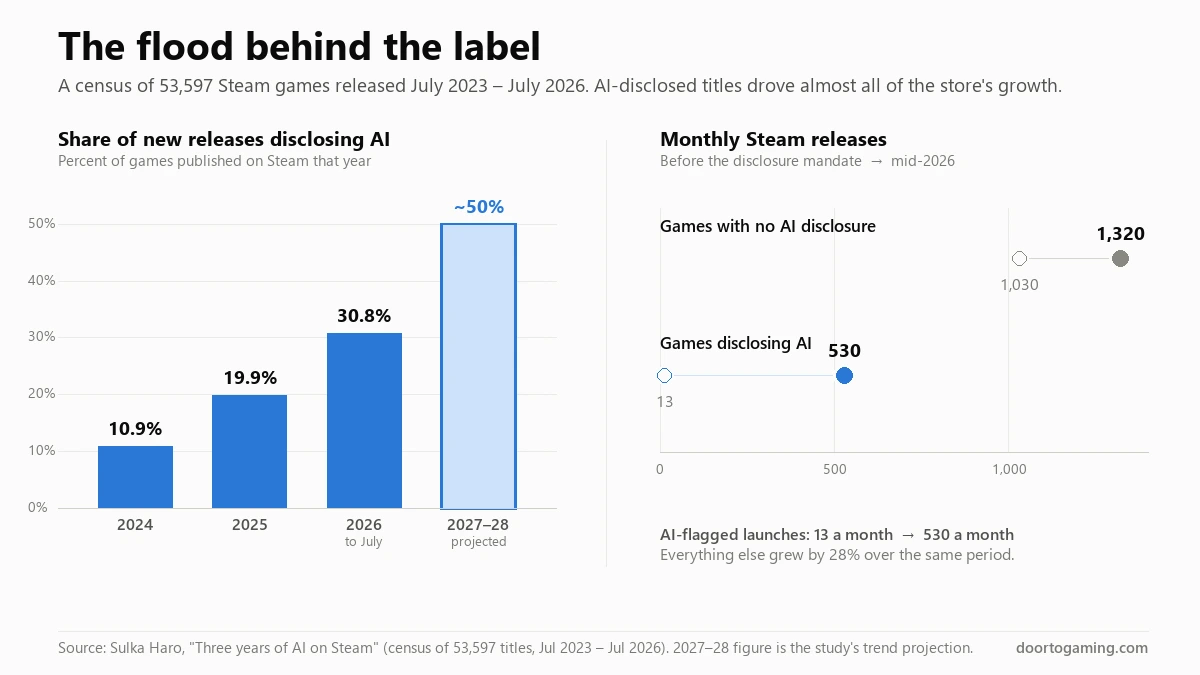
The best picture of what that checkbox actually covers comes from a different piece of work entirely: a full census of 53,597 Steam games released between July 2023 and July 2026, compiled by Sulka Haro. Not a sample — every game. The charts at the top of this page come from it.
The share of new Steam releases carrying an AI disclosure went from 10.9% in 2024 — the first year the mechanism existed, after Valve mandated it that January — to 19.9% in 2025, to 30.8% across 2026 through July. One in three. On the current trajectory it crosses half of all releases somewhere in 2027 or 2028.
But the volume figures are where it gets stark. Games without an AI disclosure went from roughly 1,030 launches a month to about 1,320 — real growth, around 28%, roughly what you would expect from a storefront that has been getting steadily easier to publish on for a decade. AI-flagged launches over the same stretch went from about 13 a month to around 530. Depending on the window you choose, somewhere between 60% and 90% of all the growth in Steam's monthly release volume is AI-disclosed games.
The sales split makes the point even more sharply, and it is moving fast. In Q1 2026, AI-flagged games were 28% of new releases and 17% of estimated sales. By Q2 they were 33% of releases and just 10% of sales. More of the catalogue, a smaller slice of the money — the gap widened by a third in a single quarter.
And they are, overwhelmingly, not working. The census puts AI-flagged games at roughly 55% of the non-AI rate for reaching even modest success. That is against a baseline that is already brutal: across Steam as a whole, the median game that gets any reviews at all makes around $300, 28% receive no reviews whatsoever, and the top 1% of titles take about 94% of all estimated revenue.
That last number should reframe the entire debate. Steam is not a market where AI games fail and human games succeed. It is a market where almost everything fails and a handful of titles take nearly all the money — and generative AI has made it dramatically cheaper to join the part that fails.
The two studies don't actually disagree
It would be easy to set these findings against each other. One says disclosure causes a large drop in comparable games; the other says AI-disclosed games are mostly a low-quality flood that was never going to sell. Pick whichever suits your position on AI.
They are both true, and they are measuring different things. Burton's model isolates what the label does to a game holding quality and pedigree constant. Haro's census describes what the labelled population actually consists of. One is a causal effect; the other is composition. The flood explains why AI-disclosed games sell badly in aggregate. The causal model explains why a good studio still takes a hit even when its game is good.
Which produces the genuinely awkward conclusion. The disclosure system charges its highest price to precisely the developers best equipped to use these tools carefully — the funded studios with art directors, review processes and someone accountable for what ships. The operations generating a storefront's worth of asset flips pay nothing, because nobody was going to buy their game either way.
Disclosure, as currently built, taxes honesty in inverse proportion to how much you have to be honest about.
You can see the same tension inside the studios themselves. In this year's GDC State of the Game Industry survey, 52% of professionals said generative AI is having a negative impact on the industry — up from 30% a year earlier and 18% the year before that. Only about 7% called the impact positive, down from 13%. And in the same survey, 52% of companies reported using generative AI in production. Roughly half the industry is using a technology roughly half the industry thinks is damaging it, which is not a contradiction so much as a description of what it feels like to work there right now.
What separates the AI games that work from the ones that don't
Buried in the census is the most practically useful finding of the lot, and it has nothing to do with the label.
AI-disclosed games that flopped overwhelmingly used the technology for visuals — around 72% of them mention generated art. The ones that found an audience tended to use it differently: multimodal and market-facing work, things like voice and localisation. Translating your game into twelve languages you could never have afforded to support is a different act from generating the art the player is looking at for forty hours.
That is a far better predictor than the checkbox. The disclosure tells you that AI touched the project. It does not tell you whether it replaced the part of the game you actually came for.
It is also worth separating this from the AI that has quietly been in your games for years. Upscaling and frame generation — the bet Nintendo made on DLSS for the Switch 2 — are machine learning doing rendering work, and no part of the current fight is about them. The disclosure system is about generative content: art, writing, voice, models.
How to actually read the label
If you are buying:
- A disclosure is not a verdict. It tells you a tool was used somewhere in a pipeline. Check what for — most store pages now say, and "localisation and placeholder voice" is a different proposition from "environment art."
- Weight the developer, not the checkbox. The label is close to meaningless on a first-time developer and highly informative on a studio with a catalogue, because the latter had a choice and made it deliberately.
- Be aware of what your reaction is selecting for. A penalty that only bites studios with reputations doesn't remove AI from games. It pushes disclosure toward the minimum a studio thinks it can get away with, which is the opposite of what the policy is for.
If you are shipping: the evidence suggests the safest use of these tools is on the work players never see as craft — pipeline, localisation, tooling — and the most expensive is on the surfaces they judge you by. And if you have an audience, assume the disclosure will be read as a statement of values rather than a technical note, because that is demonstrably how it is being read.
The label is doing a job nobody designed it for
Valve built the AI disclosure as a consumer-information feature: a factual note about how a product was made, in the same spirit as listing which languages it supports.
It has become something else. It is now a trust signal, priced by the audience, charged against reputation, and almost entirely uncorrelated with whether the game in front of you is any good. One in three new Steam releases carries it. By 2028 it will likely be most of them, at which point a label that flags a third of the store flags nothing at all.
The useful question was never whether a game used AI. It is whether anyone was accountable for the result — and that is precisely the thing a checkbox cannot tell you.
Tags: Gaming Industry PC Gaming Indie Games Valve Generative AI AI in Gaming Steam Steam AI Disclosure Game Development Larian Studios
Written by Shujaat Ahmed
Shujaat Ahmed is the founder and editor of Door To Gaming. A lifelong gamer, he writes about the games, hardware, and industry news he cannot stop thinking about.