Sony Fixed PSSR in March. Almost Nobody Had It Switched On.
The September firmware was reported as PSSR 2.0 arriving on PS5 Pro. It arrived in March — as an optional setting most owners never found. What changed last week was a default, and that turns out to be the most consequential PS5 Pro graphics decision of the year.
By Shujaat Ahmed · · · 7 min read
On September 16, 2026, Sony released PS5 system software 26.06-14.00.00, and the coverage framed it as PSSR 2.0 arriving on PS5 Pro.
It did not arrive. It had been there since March.
What actually changed on September 16 is that a checkbox buried in the settings menu got ticked for you. That sounds like a footnote. It is the most consequential thing to happen to PS5 Pro image quality all year, and it says something uncomfortable about how console graphics features actually reach the people who own the hardware.
The upgrade shipped six months earlier
On March 16, 2026, Sony announced the upgraded PSSR pipeline and named the games getting it: Silent Hill 2 and Silent Hill f, Monster Hunter Wilds, Final Fantasy VII Rebirth, Crimson Desert, Dragon Age: The Veilguard, Control, Alan Wake 2, Senua's Saga: Hellblade II, Nioh 3, Rise of the Ronin, Resident Evil Requiem and Dragon's Dogma 2, with Assassin's Creed Shadows and Cyberpunk 2077 following.
The improvements Sony listed were specific: more precise image reconstruction, better motion stability, reduced flickering and afterimage artifacts, and sharper fine detail on the things that always betray an upscaler — hair, grass, foliage edges.
Crucially, it was delivered through a system software update, not per-game patches. And for existing supported games, players could turn it on through an optional PS5 Pro system setting.
Optional. That word did all the damage.
The September update is a defaults change
Six months later, firmware 26.06-14.00.00 switched "Enhance PSSR Image Quality" on by default, after an August beta trialled the behaviour.
Read the September patch notes and the rest is housekeeping: an on-screen display of who is speaking in voice chat, a Community Activity widget in the Welcome Hub, a Bluetooth toggle aimed at esports venue management, and general stability work.
The PSSR line is the only one that changes how games look. And it changes how they look not by improving anything, but by applying an improvement that already existed to people who never went looking for it.
Sony spent six months shipping a better upscaler to a settings menu. The fix was not engineering. It was admitting that opt-in graphics features reach almost nobody.
That is the real story, and it generalises well beyond PlayStation. Console owners are not PC enthusiasts. They do not audit their graphics settings after a firmware update. A feature that requires a deliberate trip into a submenu is a feature most of the install base will never experience, no matter how good it is.
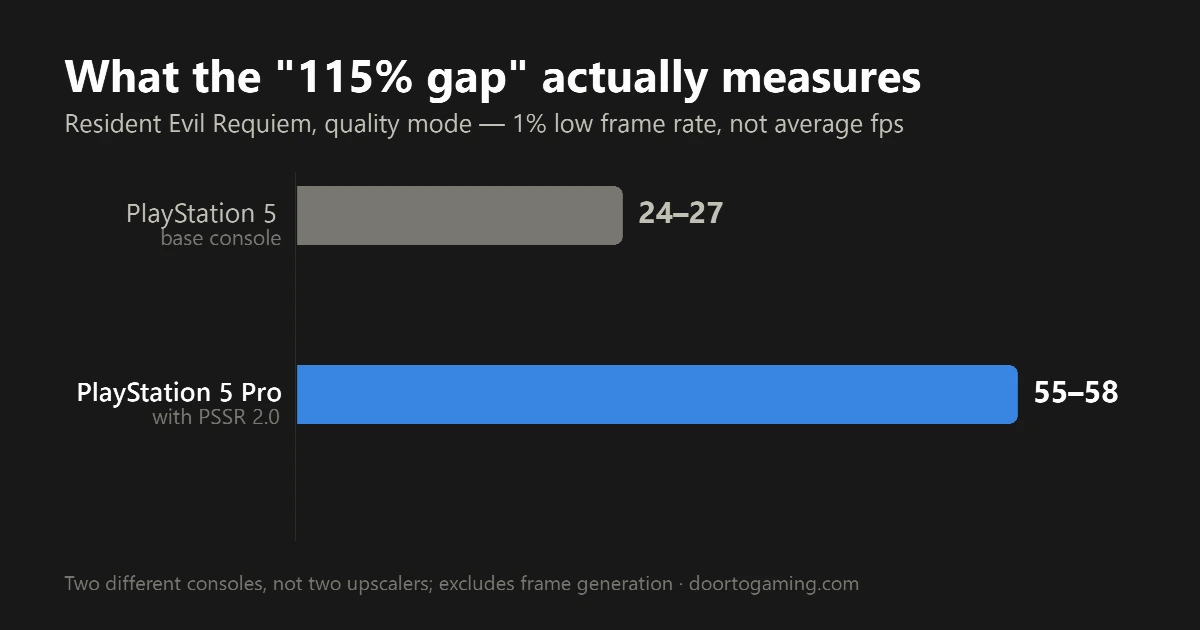
What the "115% gap" number actually measures
There is a figure circulating alongside this update — a 115% gap — usually presented as though it compares upscalers. DLSS 4.5 against FSR 4.1 against PSSR 2.0, with a triple-digit number attached.
It does not compare upscalers.
The 115% is the difference in 1% low frame rate in Resident Evil Requiem, measured between a base PS5 and a PS5 Pro running PSSR 2.0, in quality mode. Base PS5 sat around 24–27fps at the 1% low; PS5 Pro reached roughly 55–58fps.
Three things follow, and all of them matter:
- It is a comparison between two different consoles, not two upscaling technologies. The Pro has substantially more GPU hardware. Of course it is faster.
- It measures the 1% low — the worst-case frame pacing, not the average. That is a legitimate and often under-reported metric, but it is not "frames per second" as most readers will understand it.
- It excludes frame generation entirely, which is precisely where DLSS's headline multipliers come from.
None of that makes the number false. It makes it useless as a three-way upscaler comparison, which is how it is being used. If you want to know whether PSSR 2.0 beats DLSS 4.5, that figure tells you nothing at all.
The risk nobody is discussing
Here is what genuinely concerns me about a default-on, system-level upscaler swap.
Sony is applying a new reconstruction pipeline, automatically, to a back catalogue of games that were tuned, tested and certified against the old one. The developers of those games shipped and validated against PSSR 1.0. Many of those studios have moved on to other projects.
We already know what happens when PSSR meets a renderer it was not designed around. When Digital Foundry tested The Outer Worlds 2, it found PSSR interacting badly with the game's Lumen and ray-traced lighting — badly enough that the game shipped with PSSR disabled on PS5 Pro, and badly enough that the far cheaper Xbox Series X delivered the better experience.
That is one documented case of the upscaler fighting the renderer. The September change takes the new pipeline and points it at everything that supported the old one, without requiring the original developers to test a thing.
To be fair to Sony, the technical case for doing it this way is real. PSSR runs on the Pro's dedicated upscaling silicon rather than competing for the main GPU pipeline, so the performance cost of swapping it is close to nil. And the reported post-update issues so far have been unrelated to PSSR — HDR calibration resetting on some LG OLED sets, slower installs on disc consoles.
But "no problems reported yet" across a catalogue this size is an early reading, not a verdict. The failure mode to watch for is not crashes. It is a specific game, with a specific lighting model, quietly looking worse than it did in August — and no patch coming, because the studio that made it has shipped and moved on.
How this compares to the PC approach
The contrast with PC is instructive, and it does not flatter either side cleanly.
Nvidia introduced DLSS 4.5 and Multi Frame Generation 6X at CES 2026, with a second-generation transformer model and frame generation multipliers that scale dynamically. AMD's FSR 4.1 improved motion handling over FSR 4, with less smearing and better reconstruction of fine detail.
On PC, upgrading your upscaler is something you do — per game, through a driver override or an in-game setting, with a benchmark tool and a forum thread to tell you whether it helped. That is enormous control and it is also enormous friction. Most PC players do not do it either.
Sony's approach trades that control away for reach. Every PS5 Pro that takes the update gets the better upscaler in every supported game, immediately, whether or not the owner knows what PSSR stands for.
For the overwhelming majority of console players, that is unambiguously the right call. Defaults are the only setting most people ever use, and a default that makes a hundred-odd games look better is worth more than a menu option that makes them look better in theory.
What to actually do about it
Take the update and leave it alone. If you own a PS5 Pro, the new behaviour is on and you want it on. The March pipeline is better than the original on every axis Sony described, and the performance cost is negligible.
You can still turn it off. The setting remains in the PS5 Pro system options. If you have a game you know intimately and it suddenly looks softer, shimmerier or ghostier than you remember, that toggle is where to start — and it is the one diagnostic step nobody will think to try, precisely because the change arrived without being asked for.
Treat the 115% figure as noise. It is a real measurement of something real, and it is not a statement about upscaler quality.
If you are still on a base PS5, none of this applies to you. PSSR is Pro hardware.
The takeaway
The technology story here is small: a better upscaler, shipped in March, now applied by default.
The interesting story is that Sony had already solved the PS5 Pro's most-criticised weakness half a year ago, and the fix sat in a submenu where almost nobody found it. Whatever engineering went into the reconstruction model, the change that actually delivered it to players was someone deciding the box should start out ticked.
That is worth remembering the next time a platform holder announces a graphics feature. The question is not whether it is good. It is whether it is on.
Tags: gaming news console gaming Game Settings
Written by Shujaat Ahmed
Shujaat Ahmed is the founder and editor of Door To Gaming. A lifelong gamer, he writes about the games, hardware, and industry news he cannot stop thinking about.