Xbox Series X vs PS5 Pro (2026): The Spec Sheet Is the Wrong Comparison
The PS5 Pro has a 37% compute advantage. Digital Foundry found it finishing behind the Xbox Series X in The Outer Worlds 2, with PSSR disabled entirely. And after August's price rise, only $100 separates them.
By Shujaat Ahmed · · 5 min read
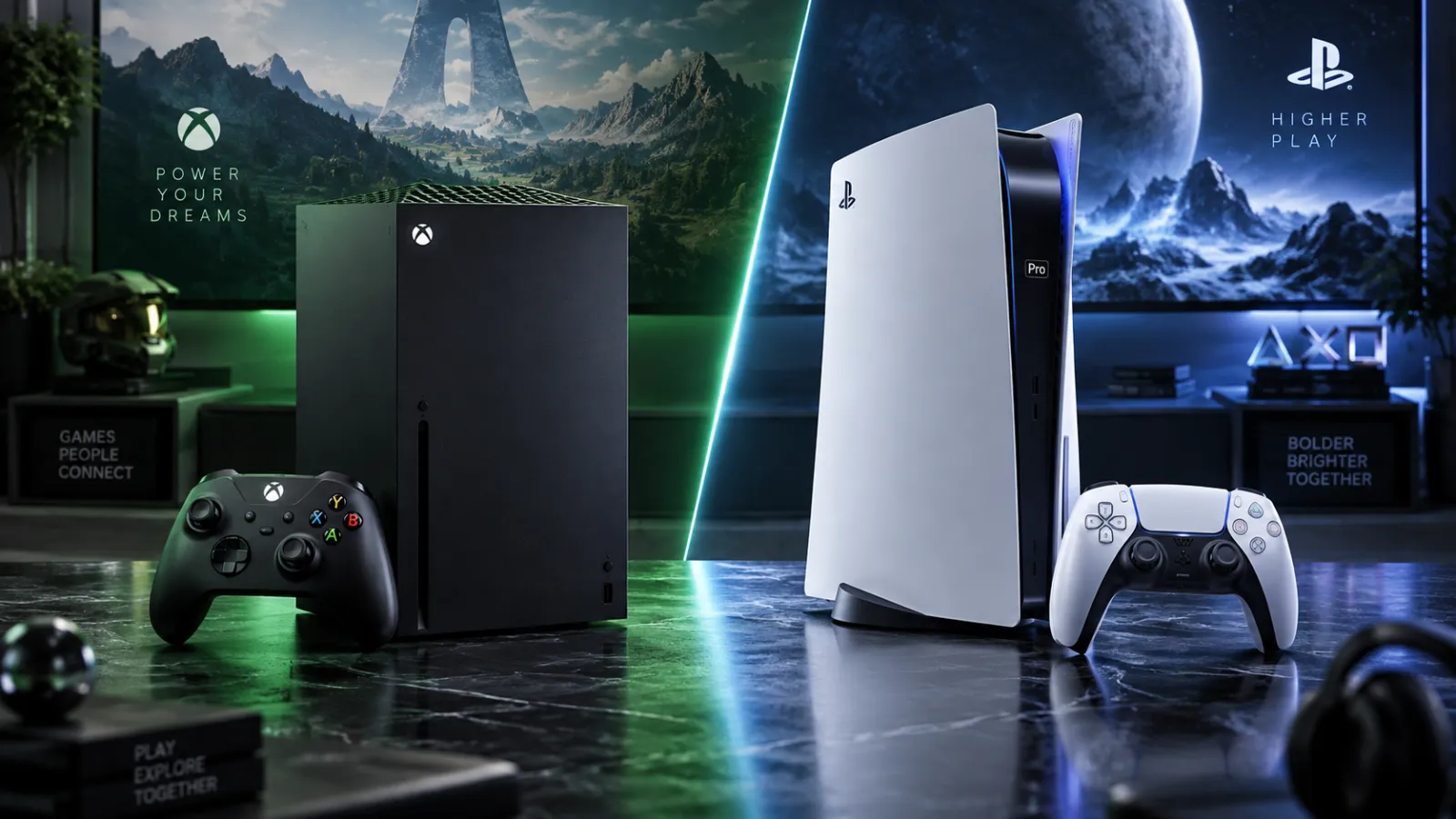
On paper this is not a close contest. The PlayStation 5 Pro has 60 compute units producing 16.7 teraflops. The Xbox Series X has 52 compute units producing 12.15 teraflops. That is roughly a 37% advantage, plus dedicated machine-learning upscaling hardware Microsoft's console simply does not have.
Then you look at what happened when someone actually measured a game running on both, and the paper stops being useful.
The test that breaks the spec sheet
Digital Foundry's analysis of The Outer Worlds 2 found the Xbox Series X version running better than either the PS5 or the PS5 Pro — and not marginally.
The PS5 version showed image breakup, lower resolution, frame-rate drops and screen tearing even in performance mode, along with small lighting downgrades. The PS5 Pro, the £/$700-plus machine with the 37% compute advantage, fared worse still in a specific and instructive way: its PSSR upscaler does not interact well with the game's Lumen and ray-traced lighting. Digital Foundry's verdict was that frame-rate dips in intense encounters were common and the general run of play was "noticeably worse than Series X."
The game went as far as disabling PSSR on PS5 Pro — the console's single biggest differentiator, switched off, because it fought the renderer.
This is one game, and one game does not overturn a generation of results where PlayStation hardware generally leads. But it demonstrates something the teraflop comparison cannot: the PS5 Pro's advantage is conditional on software cooperating with it. PSSR is a custom upscaler that developers must integrate well. When it meets a rendering pipeline it was not designed around — particularly Unreal's Lumen — the premium hardware can finish behind the cheaper box.
What each machine actually is
PlayStation 5 Pro — 60 compute units, 16.7 teraflops, built on an RDNA 2 foundation with ray-tracing and machine-learning hardware borrowed from later AMD architectures. PSSR, Sony's ML upscaler, is the headline feature. $899.99.
Xbox Series X — 52 compute units, 12.15 teraflops, RDNA 2. No ML upscaling equivalent. $799.99 for the 1TB disc model, or $749 for the 1TB digital version.
Base PlayStation 5 — 36 compute units, 10.28 teraflops, for reference on what the Pro is actually upgrading from.
The gap between Pro and Series X is real. It shows up most reliably in games with a PS5 Pro patch that uses PSSR well, where you get either a higher resolution at the same frame rate or a steadier frame rate at the same resolution. In cross-platform titles without specific Pro work, the two are frequently much closer than 37% would suggest.
The prices moved, and that matters more than the specs
The comparison people were having a year ago is obsolete, because Microsoft repriced the entire Xbox line.
On June 25, 2026, Xbox announced increases taking effect August 1, 2026:
- Xbox Series X (1TB, disc): $649 → $799 — a $150 rise
- Xbox Series X (1TB, digital): $599 → $749
- Xbox Series S (512GB): $399 → $499
- Xbox Series S (1TB): $449 → $599
Microsoft's stated reason is worth quoting in substance, because it is unusually candid: console storage and memory prices have risen by more than 2.5x, and the company expects another doubling by the fall of 2027.
That is not a margin decision. It is the same AI-driven memory reallocation that has repriced desktop RAM and starved NVIDIA's planned GDDR7 refresh, arriving at the console aisle. Microsoft has told you, in public, that it expects the component cost to double again within about a year.
The practical effect on this comparison: the Series X's traditional argument — comparable performance for meaningfully less money — has narrowed to $100 against a PS5 Pro that is substantially more capable on paper.
So which should you buy?
The honest answer depends on three questions, none of which is "which has more teraflops."
Which exclusives do you actually want? This remains the only consideration that reliably matters. PlayStation's 2026 first-party output has been thin, and the games meant to anchor it have slipped — God of War: Laufey is dated February 16, 2027, and Marvel's Wolverine divided critics sharply. Xbox, meanwhile, puts first-party releases on Game Pass day one, and Gears of War: E-Day arrives October 6 on that basis.
Do you have a display that can use the Pro? The PS5 Pro's advantage is largely resolution and ray-tracing headroom. On a 4K screen with VRR and 120Hz support, you will see it. On a 1080p or basic 4K60 television, much of the $100 premium goes unused, and the Series X becomes the sensible buy.
How much do you value Game Pass? Over a two- or three-year ownership period, a subscription that includes first-party titles at launch changes total cost of ownership far more than $100 of hardware price difference.
A note on buying timing
Given Microsoft's own warning about component costs doubling again by fall 2027, the usual advice to wait for a better price looks weak. There is no obvious mechanism by which either console gets cheaper in the next year — the pressure runs the other way, and Microsoft raised prices mid-generation rather than late in it, which is not normal.
If you want a console this generation, the case for buying sooner is stronger than it has been at any point since launch. That is an unusual thing to write, and it is a direct consequence of the memory market rather than anything to do with either machine.
The takeaway
The PS5 Pro is the more powerful console and the spec gap is genuine. But 16.7 against 12.15 teraflops is a much worse predictor of what you will experience than it looks, because the Pro's advantage runs partly through PSSR — and PSSR is software-dependent in a way raw compute is not. The Outer Worlds 2 is the proof: the expensive machine came third.
Buy for the games you want to play and the display you own. Then, if you are choosing on hardware alone, note that $100 now separates them, and that both companies are telling you components are getting more expensive rather than less.
Tags: Xbox vs PlayStation 2026 PS5 Pro vs Xbox Series X Xbox Series X performance PS5 Pro performance best gaming console 2026 Xbox vs PS5 performance PS5 Pro vs Xbox graphics
Written by Shujaat Ahmed
Shujaat Ahmed is the founder and editor of Door To Gaming. A lifelong gamer, he writes about the games, hardware, and industry news he cannot stop thinking about.