In D-topia You're Not Living in the Utopia. You're Maintaining It.
Marumittu Games' puzzle adventure casts you as the Facilitator — the human upkeep layer in an AI-run society — and splits the world into a polished public face and a glitching Block Side underneath. The idea is sharper than the puzzles built on it.
By Shujaat Ahmed · · · 5 min read
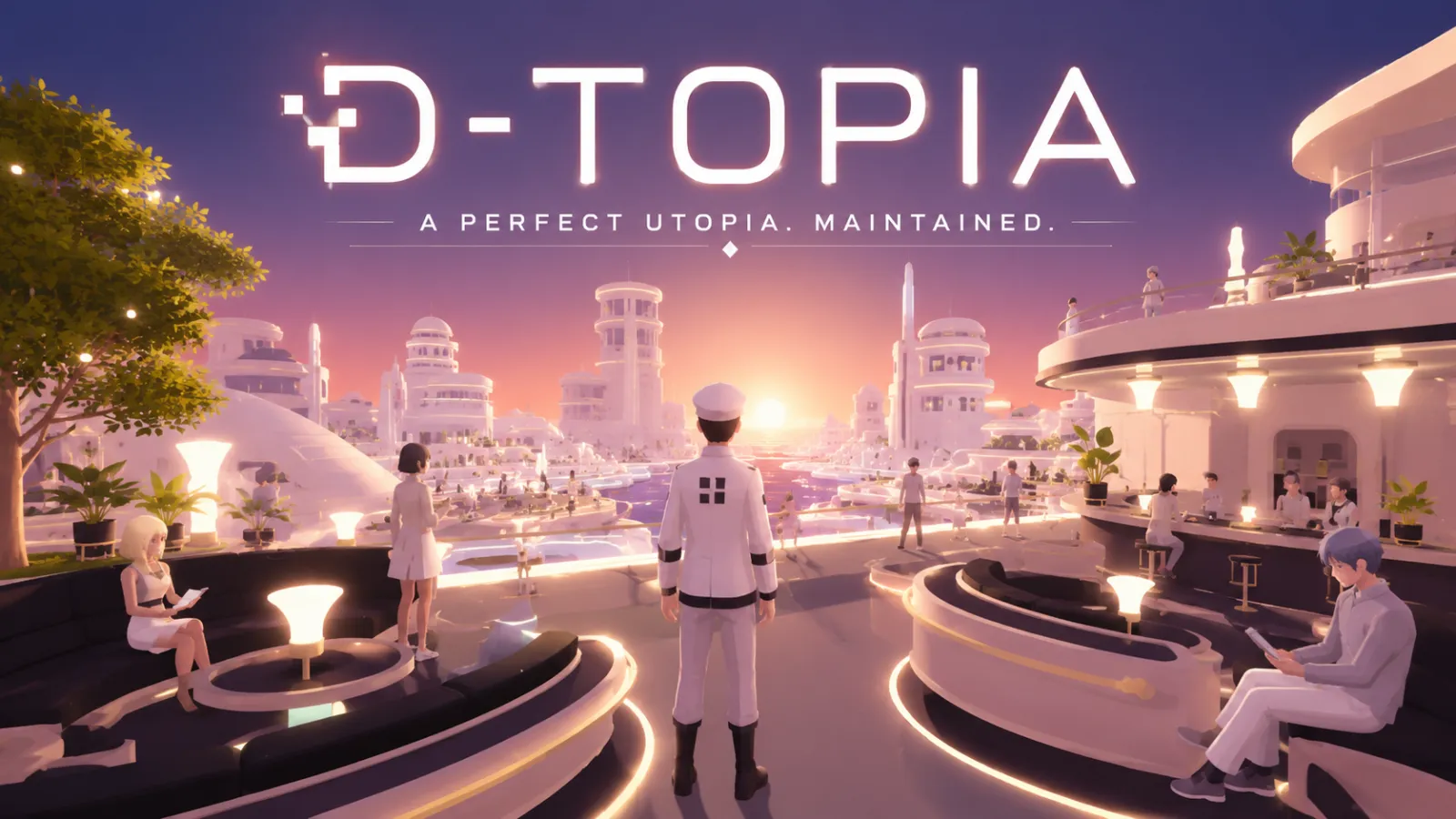
D-topia arrived on July 14, 2026 from Marumittu Games, published by Annapurna Interactive, across PC and consoles. Clean Scandinavian minimalism, a lo-fi soundtrack, quirky residents, gentle logic puzzles.
It is also a game about maintaining an illusion for an AI, and the tension between those two descriptions is the entire design.
You are the Facilitator
The premise is more pointed than the art style suggests. You play the Facilitator in a utopian society controlled by AI, and your job is upkeep: keep the residential complex running, repair machines, help the residents with their problems, solve the logic puzzles that stand between you and a functioning building.
Note what that role actually is. You are not a resident enjoying the utopia. You are the maintenance layer that makes the utopia appear to work — the human component in a system that has automated everything except the part where things go wrong.
For a game released in 2026, that is not a subtle premise, and it is better for being stated plainly rather than treated as a twist.
The Block Side is the mechanic
The structural idea is what separates D-topia from the broader cosy-with-a-secret genre.
The game runs two overlapping spaces: the polished public environment, and a concealed counterpart called the Block Side — unstable, glitching, and the same place seen without the presentation layer.
That is a strong design metaphor because it is literally a rendering of the premise. The utopia is a surface. The Block Side is the system underneath it, visibly failing. And you, as Facilitator, are the only one who moves between them.
Where this is smarter than the usual "cute game with a dark secret" structure is that the darkness is not a reveal withheld for the third act. It is a space you inhabit, repeatedly, as part of the job. The game is not tricking you about what it is. It is asking you to keep working anyway.
The reviews landed mixed, and the reason is instructive
Metacritic records "mixed or average" reviews across the PC, Xbox Series X and Switch 2 versions, while OpenCritic has 64% of critics recommending it.
Those two numbers are not in conflict — they describe a game most critics would tell you to play while declining to call it excellent. That is a common landing spot for games where the idea outperforms the execution.
The usual culprit in this genre is puzzle design. A game whose appeal is atmosphere and theme still has to fill hours with things to actually do, and logic puzzles are the most common filler because they are cheap to produce and hard to make memorable. When a game like this reviews as mixed, it is frequently because the puzzles are competent, repetitive, and sit between the player and the part they came for.
The dual-space structure carries its own risk too: moving between two versions of the same environment is elegant the first time and can become traversal the twentieth.
The genre problem D-topia is standing in
There is a broader context worth naming, because it is not entirely this game's fault.
The "cosy aesthetic concealing something unsettling" premise has been thoroughly mined over the last decade. It was genuinely startling when it was new. It is now a recognisable subgenre with recognisable beats, and audiences arrive already looking for the seams.
That creates an unfair burden. D-topia's AI-utopia framing and Block Side mechanic are real contributions to the form. But a player who has been through several of these already will spot the shape early and spend the game waiting for confirmation rather than being unsettled by it.
Annapurna's involvement cuts both ways here as well. The publisher's name signals a certain kind of thoughtful, aesthetically confident, emotionally weighted experience — which draws an audience and simultaneously sets an extremely high bar for comparison against its own catalogue.
Should you play it?
Play it if the premise interests you more than the puzzles do. The Facilitator role and the Block Side are the reasons this game exists, and they deliver.
Play it if you want something calm with substance underneath. The presentation is genuinely accomplished — the minimalism, the sound design and the residents are the part nobody has criticised.
Be realistic about the puzzles. Mixed reviews for a game like this usually mean the moment-to-moment activity is the weak link. If you need puzzle design to be the draw rather than the connective tissue, this is not that game.
Skip it if you have played several games in this subgenre recently. You will likely see where it is going, and seeing where it is going removes most of the effect.
The takeaway
D-topia is a well-made, thematically sharp puzzle adventure about being the person who keeps an automated utopia looking functional — with a two-world structure that turns that idea into something you physically move through rather than merely read about.
It reviewed as mixed-to-positive because the framework is more interesting than the puzzles inside it. That is a real limitation and a fairly forgivable one. The Facilitator is a genuinely good idea, and the Block Side is a genuinely good way to express it.
If you want the idea, it is here. If you want a great puzzle game that happens to have an idea, the critics have been honest with you about which one this is.
Tags: PC Gaming Indie Games Cozy Games Nintendo Switch xbox series x D-topia Annapurna Interactive Puzzle Adventure Game Review Dystopian Games PS5
Written by Shujaat Ahmed
Shujaat Ahmed is the founder and editor of Door To Gaming. A lifelong gamer, he writes about the games, hardware, and industry news he cannot stop thinking about.