The Mound Solved the Problem That Ruins Every Co-Op Horror Game
Four friends with voice chat is an anti-horror machine — fear doesn't survive being able to confirm things with each other. ACE Team's answer: per-player hallucinations plus spatial voice chat, so nobody can tell whether a teammate saw something or is losing their mind.
By Shujaat Ahmed · · 5 min read
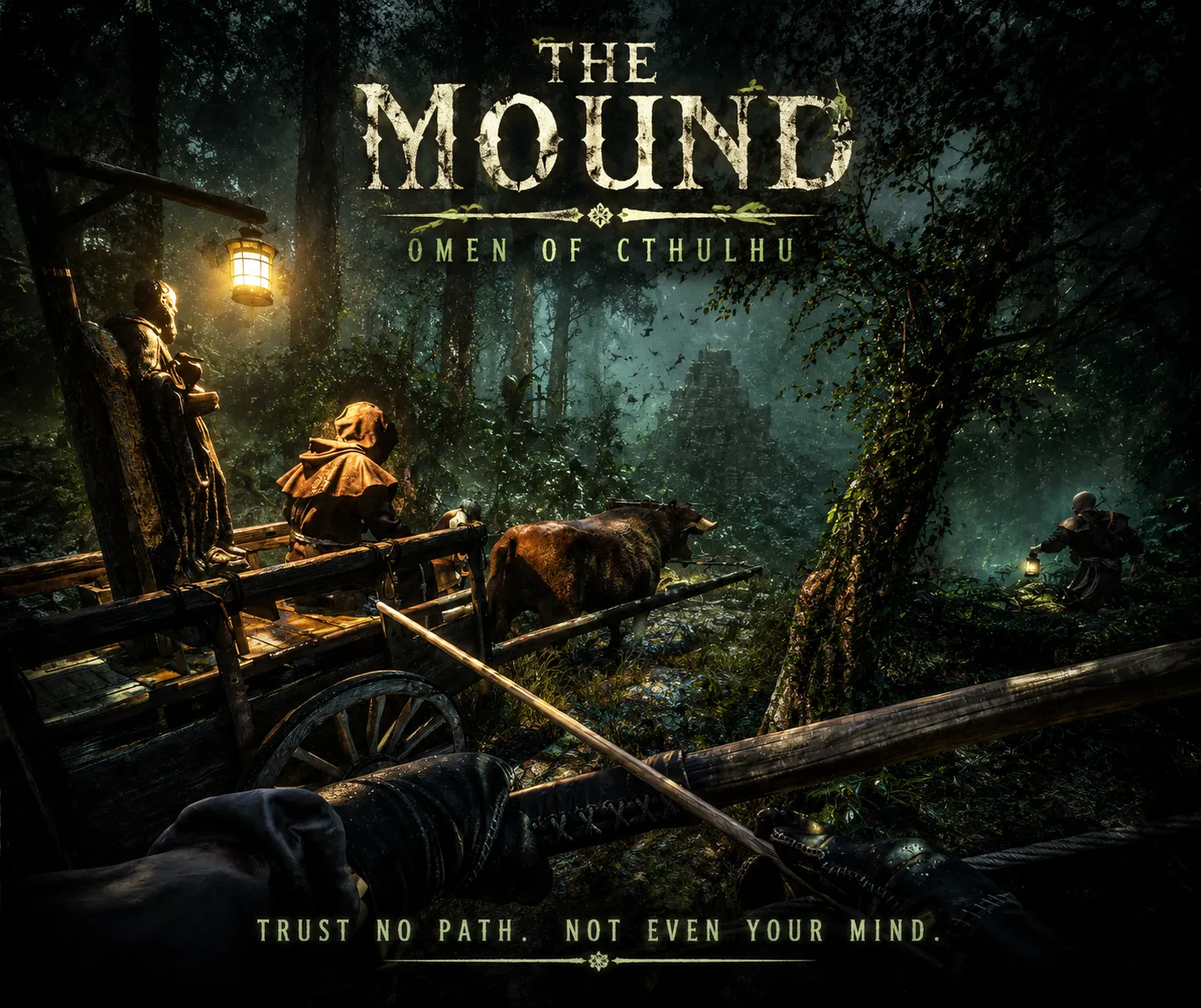
The Mound: Omen of Cthulhu arrived on July 15, 2026 from ACE Team, published by Nacon, on PS5, Xbox Series X|S and PC with full cross-play. Four players, a cursed conquistador-era jungle, twenty-minute runs, scavenge and extract.
Described that way it sounds like every extraction game of the last three years with Lovecraft paint on it. The thing that makes it work is a combination of two systems that, together, do something co-op horror almost never manages.
Hallucinations are per-player, and voice chat is spatial
Each player has a personal sanity meter, and as it drops, the game spawns hallucinations specific to that player. What you see is not what your teammates see.
Separately, the game uses spatial voice chat — you hear threats positionally, before you see them, and you hear your teammates from wherever they actually are.
Run those two systems at once and something genuinely unusual emerges: your teammates become unreliable narrators, and so do you.
When someone shouts that there is something in the treeline, there is no way to know whether they are calling out a real threat or describing their own deteriorating mind. When you see something and call it out, you cannot be certain you are not the one hallucinating. And because voice chat is positional rather than a clean radio channel, the panic in someone's voice arrives with distance and direction attached, which makes it harder to dismiss.
Most co-op horror games fail in exactly this area. Four players with voice chat and shared information is an anti-horror machine — fear does not survive being able to confirm things with your friends. The Mound's answer is to make confirmation impossible without removing communication.
That is a smart, specific design solution to the central problem of the genre.
The scores are mixed, and fairly so
The reception was respectable rather than triumphant: 70 on Metacritic from eight PC critics, with Steam user reviews sitting around 65% positive from more than 1,600 reviews shortly after launch.
That is the profile of a game with a genuinely good idea and rough execution around it — which is a common and honest place for a mid-budget co-op title to land.
The structure explains part of it. Twenty-minute runs built around scavenge, survive and extract is a loop that lives or dies on variety and stability. Extraction games need a lot of content churn to stay interesting, and they need matchmaking that works, because a co-op game with a thin population becomes unplayable regardless of design quality.
A 65% positive Steam score generally indicates people enjoyed the core and hit friction — technical issues, repetition, balance — around it.
ACE Team is a reason to pay attention
Worth knowing who made this, because it colours what to expect.
ACE Team are the Chilean studio behind Zeno Clash and Rock of Ages — games defined by genuinely strange art direction and mechanical ideas that no committee would approve. They have never been a studio that produces polished, conventional products. They produce interesting ones.
A conquistador-era Lovecraftian jungle with per-player hallucinations is entirely consistent with that record. So, unfortunately, is a 70 on Metacritic. ACE Team games tend to have a great idea at the centre and unevenness around the edges, and reviewers have been marking them that way for fifteen years.
If you already know that about the studio, the score will not surprise you and probably will not deter you.
The Lovecraft framing actually fits
Sanity mechanics in games are usually decorative — a meter that drains and applies a screen filter. Here the mechanic does real work, because it attacks the thing the players rely on most.
Lovecraft's horror was never really about monsters. It was about knowledge that damages the person who acquires it, and about narrators you cannot trust because they are describing events that broke them. A game where your perception degrades privately, while you are obliged to keep reporting what you perceive to three other people, is closer to that idea than most licensed Cthulhu products manage.
The conquistador setting reinforces it — explorers in a place they do not understand, pursuing treasure, with the expedition itself as the mistake.
Should you play it?
Play it if you have a regular group of three friends and you want co-op horror that resists the usual dissolution into banter. The sanity and voice systems are built specifically to prevent that, and they work.
Play it if you liked Zeno Clash or Rock of Ages and you want to see what ACE Team does with a modern multiplayer structure. This is recognisably the same studio.
Be cautious if you play solo or rely on matchmaking. This is a four-player design, and extraction games with modest player counts get harder to fill over time. Check current player numbers before buying.
Be cautious if a 70 and 65% positive would bother you. The rough edges reviewers found are real, and this is not a game that will be mistaken for a polished blockbuster.
The takeaway
The Mound: Omen of Cthulhu is a mid-budget co-op horror game that scored a 70, and it contains one of the more interesting design ideas of the year.
Per-player hallucinations plus spatial voice chat turns a group of friends into a set of unreliable witnesses without taking away their ability to talk — which is the specific problem that has defeated co-op horror since the genre existed.
The execution around that idea is uneven. The idea itself is worth someone stealing and building a better game around.
Tags: gaming news PC Gaming xbox series x The Mound Omen of Cthulhu The Mound game ACE Team extraction horror psychological horror games co-op horror games Lovecraftian games survival horror 2026 indie horror games psychological sanity mechanics multiplayer horror
Written by Shujaat Ahmed
Shujaat Ahmed is the founder and editor of Door To Gaming. A lifelong gamer, he writes about the games, hardware, and industry news he cannot stop thinking about.