Minecraft Sulfur Caves: Sulfur Cubes Aren’t Hostile — They’re a Physics Object You Configure
Sulfur Cubes are passive, not hostile — but they spawn on the hostile mob cap, which is why so many players assume otherwise. Where Sulfur Caves generate and at what Y level, how to find one from the surface, what the cube drops, and the 12 archetypes you can configure it into.
By Shujaat Ahmed · · · 7 min read
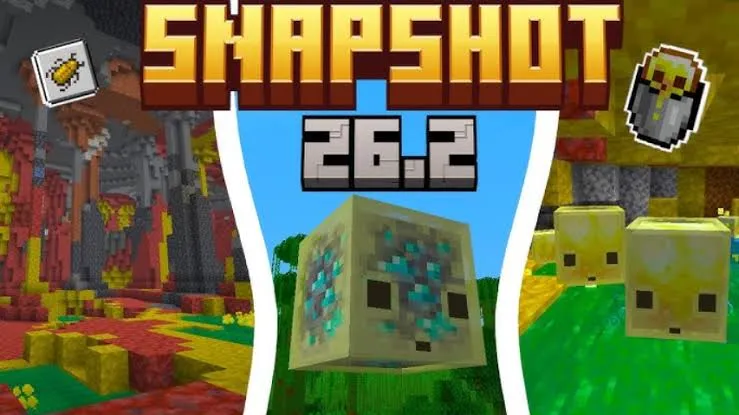
Short answer: no. The Sulfur Cube is a passive mob. It will not chase you, it will not attack you, and it does not deal contact damage. If you stand next to one it will keep bouncing around and ignore you completely.
But there is a reason so many players assume otherwise, and it is a genuinely odd piece of design: the Sulfur Cube is passive, yet it spawns like a hostile mob. It belongs to the hostile mob cap and competes with hostile mobs for spawning space. So it appears in the dark, underground, in the same places and under the same rules that spawn things trying to kill you — and it looks like a slime, which is a mob people associate with damage.
It is also the only mob in Minecraft whose physics you can rewrite, which is the part worth staying for.
Are sulfur cubes hostile? The full answer
To be precise about what that means in practice:
- It has 8 health and moves by jumping, like a small slime.
- It will not target you, follow you, or damage you by touching you.
- It spawns on the hostile mob cap, so lighting up a Sulfur Cave to stop hostile spawns stops Sulfur Cubes too — and conversely, a cave full of Sulfur Cubes is using up spawn slots that zombies and skeletons would otherwise fill.
- When killed it splits into smaller versions, again like a slime.
The one way a Sulfur Cube becomes dangerous is if you make it dangerous. Feed it TNT and you have built a rolling bomb. That is a choice you make, not something the mob does to you.
(If you spell it sulphur — as most of the world outside the US does — everything here applies; Minecraft uses the American spelling for the block, the mob and the biome.)
What are sulfur caves in Minecraft?
The Sulfur Caves are an underground cave biome added in the Chaos Cubed update. They are immediately recognisable: the stone is streaked with bands of bright yellow sulfur and deep red cinnabar, and the floor is broken up by sulfur pools containing potent sulfur.
Three things make the biome different from the cave biomes that came before it:
- Cave spiders spawn instead of regular spiders. This is the actual danger in a Sulfur Cave, and it is easy to walk into while you are busy looking at a harmless bouncing cube.
- Sulfur Cubes spawn here and nowhere else. The biome is the only source of the mob.
- It announces itself from the surface. Sulfur Caves generate with surface springs above them, in four sizes — small, medium, large and extra-large.
Where to find sulfur caves, and at what Y level
This is the question with the least official documentation, so it is worth separating what Mojang states from what players have measured.
Officially: the biome generates naturally underground, and inside hills and mountains.
From community testing, the practical numbers are:
- Sulfur Caves appear across roughly the same range as lush and dripstone caves, but cluster noticeably between Y −16 and Y −48, which makes them shallower on average than dripstone caves.
- They generate most often under warm, dry surface biomes — deserts and badlands are the best places to dig.
Three ways to actually find one, in order of reliability:
- Follow the sulfur springs. This is the intended route and by far the fastest. Find a yellow, bubbling spring formation on the surface, then dig down beside it rather than straight through it — digging through the spring itself tends to drop you into the water rather than the cavern.
- Strip mine a dry biome. Head to a desert or badlands and mine down to around Y −20 to −40. That band intersects Sulfur Caves more often than anywhere else.
- Use a command. If you have cheats on,
/locate biome minecraft:sulfur_cavesreturns the coordinates of the nearest one.
What do sulfur cubes drop?
Nothing. The Sulfur Cube has no loot drops at all. Kill one and it splits into smaller cubes; kill those and you get nothing.
This is worth saying plainly because it changes how you should treat the mob. There is no farm to build, no resource to grind. The Sulfur Cube is not a source of materials — it is a thing you use, and what it is useful for depends entirely on what you feed it.
The part that makes it interesting: 12 archetypes
Most Minecraft mobs have fixed properties. A creeper explodes, a slime bounces, a zombie walks. You learn the behaviour once and it is a constant.
The Sulfur Cube does not work that way. Hold a block and interact with it, and the cube absorbs the block, disables its own AI, and takes on physical properties derived from what it ate. It stops being a creature and becomes an object you have configured.
There are 12 archetypes in total: regular, bouncy, slow bouncy, fast flat, slow flat, light, fast sliding, slow sliding, high resistance, sticky, explosive, and hot.
In practice that means feeding it ice turns it into something that slides like a hockey puck. Feeding it TNT turns it into a rolling grenade. Feeding it a sticky block makes it cling. You are not taming a mob so much as assembling a physics prop out of one.
That is a genuinely unusual thing for Minecraft to add. The game has plenty of mobs you can influence — breeding, taming, converting — but nothing else where the mob stops being an agent and becomes a configurable object with properties you chose. For anyone building redstone contraptions, adventure maps or parkour courses, that is a far more significant addition than a new cave biome normally is.
What else the Chaos Cubed update added
The biome does not arrive alone. Alongside it:
- Sulfur and cinnabar building blocks — new palettes in yellow and deep red.
- Potent sulfur, found in the sulfur pools.
- Erupting geysers, and the surface sulfur springs in their four size variants.
Which Minecraft version added sulfur caves?
Sulfur Caves and the Sulfur Cube shipped in Minecraft 26.2, the "Chaos Cubed" update, released on June 16, 2026 — Java Edition 26.2 and Bedrock Edition 26.30.
If you are on an older version you will not find the biome at all, no matter how far you dig. /locate biome minecraft:sulfur_caves returning an error is the quickest way to confirm your world predates it.
Quick answers
- Are sulfur cubes hostile? No. Passive, 8 health, no contact damage — but they spawn on the hostile mob cap.
- What do they drop? Nothing. They split into smaller cubes when killed.
- Where do sulfur caves generate? Underground and inside hills and mountains; community testing puts them most often at Y −16 to −48, usually under deserts and badlands.
- How do I find one? Look for surface sulfur springs and dig down beside them, strip mine a dry biome around Y −20 to −40, or use
/locate biome minecraft:sulfur_caves. - What version? Minecraft 26.2 "Chaos Cubed", 16 June 2026 (Bedrock 26.30).
- What is actually dangerous down there? Cave spiders, which replace regular spiders in this biome.
If you are heading down to look for one, it is worth making the trip look good — our roundup of which Minecraft shaders are still actually maintained in 2026 covers the packs that most change how cave biomes read. And for what Mojang is building next, we went through everything confirmed about The Sift, the first new dimension in 14 years.
Tags: Minecraft 26.2 Minecraft Sulfur Caves Sulfur Cube Minecraft snapshot update Minecraft new biome Minecraft new mob Minecraft sulfur update Minecraft Cinnabar ore Mercury Shards Minecraft Minecraft experimental update Minecraft underground biome Minecraft physics mob Mojang snapshot Minecraft modding Minecraft creators update Minecraft gameplay update Minecraft caves update Minecraft news Minecraft survival Minecraft Overworld update
Written by Shujaat Ahmed
Shujaat Ahmed is the founder and editor of Door To Gaming. A lifelong gamer, he writes about the games, hardware, and industry news he cannot stop thinking about.