Forza Horizon 6 Isn't Horizon in Japan. It's Horizon Rebuilt Around Touge.
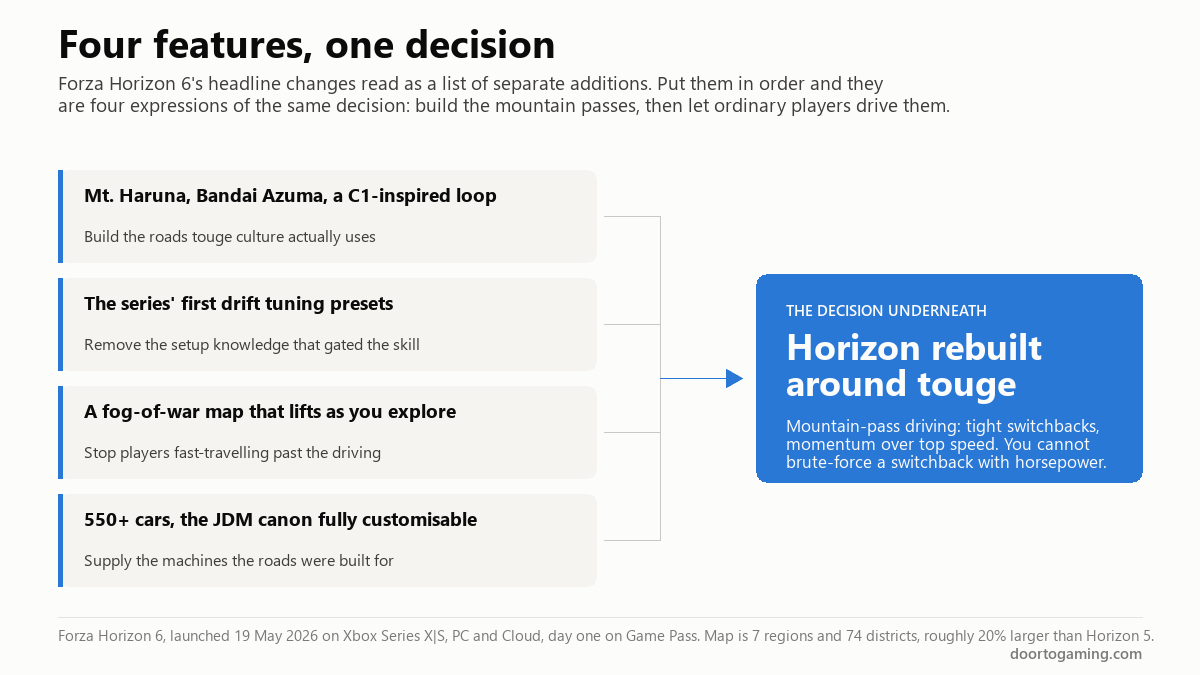
Seven regions, 74 districts, a fog-of-war map, 550+ cars and the series' first drift tuning presets. Those aren't four features — they're four expressions of one decision: build the game around mountain-pass driving, then let ordinary players actually do it.
By Shujaat Ahmed · · · 6 min read
Forza Horizon 6 launched on May 19, 2026 for Xbox Series X|S, Windows PC and Xbox Cloud Gaming, day one on Game Pass — Premium Edition buyers got in four days early, on May 15.
Every preview called it "Horizon goes to Japan." That undersells what Playground actually built. Look at the map structure, the new tuning systems and the progression rework together, and they all point at one thing: this is Horizon rebuilt around touge.
The map is 7 regions and 74 districts
The headline number is that Japan is roughly 20% larger than Forza Horizon 5's Mexico, and Xbox describes it as the series' most dense map yet, with Tokyo as the largest urban area in franchise history.
But size is the least interesting part. The structure is:
- 7 large regions, subdivided into 74 districts
- A fog-of-war system that lifts as you explore, rather than handing you the whole map at once
- Terrain running from Tokyo's downtown streets to the snowy Japanese Alps
That fog-of-war choice is the tell. Previous Horizon games gave you the map and let you fast-travel across it almost immediately; discovery was about finding collectibles on terrain you already knew. Gating the map behind exploration makes the act of driving somewhere new the reward again — which only works if the roads themselves are worth driving.
Which brings us to the roads.
The routes are the real content
Playground did not build generic Japanese countryside. It built specific, named driving culture:
- Routes inspired by the C1 loop — Tokyo's elevated expressway ring, the spiritual home of late-night highway running
- Ginkgo Avenue, the tree-lined boulevard
- Mountain passes including Mt. Haruna and Bandai Azuma
Mt. Haruna is not a random pick. It is the real mountain that the most famous touge manga in existence used as its setting, and it has been a pilgrimage route for driving enthusiasts for decades. Putting it in the game is a statement about who this map is for.
Touge — mountain-pass driving, tight switchbacks, momentum over top speed — asks for a completely different skill set than Horizon's traditional open desert blasting. You cannot brute-force a switchback with horsepower.
The drift tuning preset is the most important new feature
Here is the change that ties everything together, and it got almost no coverage: Forza Horizon 6 includes the first dedicated drift tuning preset system in the series.
Anyone who has tried to build a drift car in a previous Horizon knows why that matters. It meant manually working through differential lock, spring rates, camber, tyre pressure and gearing — a genuine engineering exercise that most players simply never attempted. The cars capable of touge-style driving existed; the knowledge required to set one up was the barrier.
A preset system removes that barrier. It converts the map's defining activity from a specialist pursuit into something any player can access on their second evening.
Put the pieces in order and the design intent is unmistakable. Build the mountain passes. Add the tuning system that makes them playable. Gate the map so people actually drive the roads rather than fast-travelling past them. That is not a setting change. It is a thesis.
550+ cars, and the ones that matter
The roster is over 550 real-world vehicles at launch, and for a Japan-set game the composition matters more than the count.
The JDM canon is present and fully customisable: Toyota Supra MK4 and MK5, Nissan Skyline GT-R R34, Mazda RX-7 FD, Honda NSX Type R, Subaru Impreza 22B, and the Toyota AE86 Trueno — the last of which is, not coincidentally, the car most associated with Mt. Haruna.
A Japan map with a thin Japanese roster would have been immediately conspicuous. This is not that.
Customisation went deeper than usual
The visual customisation is unusually granular this time:
- Window Stickers, letting you apply designs to glass as well as bodywork
- Forza Aero body kits
- Front spoilers, rear wings and side skirts customisable independently — endplates, wing surfaces and supports can each take their own paint and materials
- Community-shared garage layouts
Independently painted wing components is a genuinely enthusiast-grade level of detail, and it exists because the car culture this map is celebrating treats visual modification as seriously as mechanical tuning.
Progression was restructured
The old wristband ranking is gone, replaced by two parallel tracks:
- Festival wristbands — 7 tiers of structured events, the traditional Horizon progression
- Discover Japan — the Collection Journal, built on stamps, barn finds and free exploration
Splitting structured racing from exploration is a sensible answer to a long-standing tension in the series. Horizon has always contained two audiences — people who want an event playlist and people who want to drive around looking at things — and previously both were funnelled through the same progression bar.
The road from reveal to release
For completeness, the timeline was unusually tight:
- September 25, 2025 — revealed at Tokyo Game Show with a teaser: a garage of callbacks to past Horizon games, a window framing Mt. Fuji, an engine turning over
- January 22, 2026 — Xbox Developer Direct brought the first real gameplay, cover cars, the new systems and the May 19 date
- May 15/19, 2026 — Premium early access, then full launch
Roughly eight months from reveal to release is brisk for a modern Xbox tentpole, and it meant comparatively little time for expectations to inflate beyond what the game could deliver.
What this piece does not cover
Two things deliberately sit elsewhere, because they deserve their own treatment: how it reviewed, and where the promised PlayStation 5 version has got to. Both are in our piece on Forza Horizon 6's reception and the missing PS5 date — short version, it is the best-reviewed game of 2026 so far, and the PS5 release still has no date attached.
The bottom line
Forza Horizon 6 is not Horizon with a Japanese skin. The mountain passes, the drift tuning presets, the fog-of-war map and the 550-car JDM-heavy roster are four expressions of the same decision: build the game around touge, then give ordinary players the tools to actually do it.
Whether that lands depends entirely on whether mountain-pass driving appeals to you. If it does, this is the most deliberately designed Horizon yet. If it does not, you are playing a very pretty open-world racer on an unusually twisty map.
Tags: Forza Horizon Forza Horizon 6 racing games open world racing car games driving simulator arcade racing Xbox racing games PC racing games Playground Games Microsoft racing open world driving car customization hypercars supercars racing festival dynamic weather racing next gen games 2026 games upcoming racing games realistic racing graphics multiplayer racing online racing car tuning open world exploration
Written by Shujaat Ahmed
Shujaat Ahmed is the founder and editor of Door To Gaming. A lifelong gamer, he writes about the games, hardware, and industry news he cannot stop thinking about.