Why PC Memory Got Expensive and Won't Get Cheap Again
An HBM module sells for $60–100. The same amount of conventional DDR5 sells for $5–10. That spread, not a shortage, is why your next build costs more — and why IDC calls this a permanent reallocation rather than a cycle you can wait out.
By Shujaat Ahmed · · · 6 min read
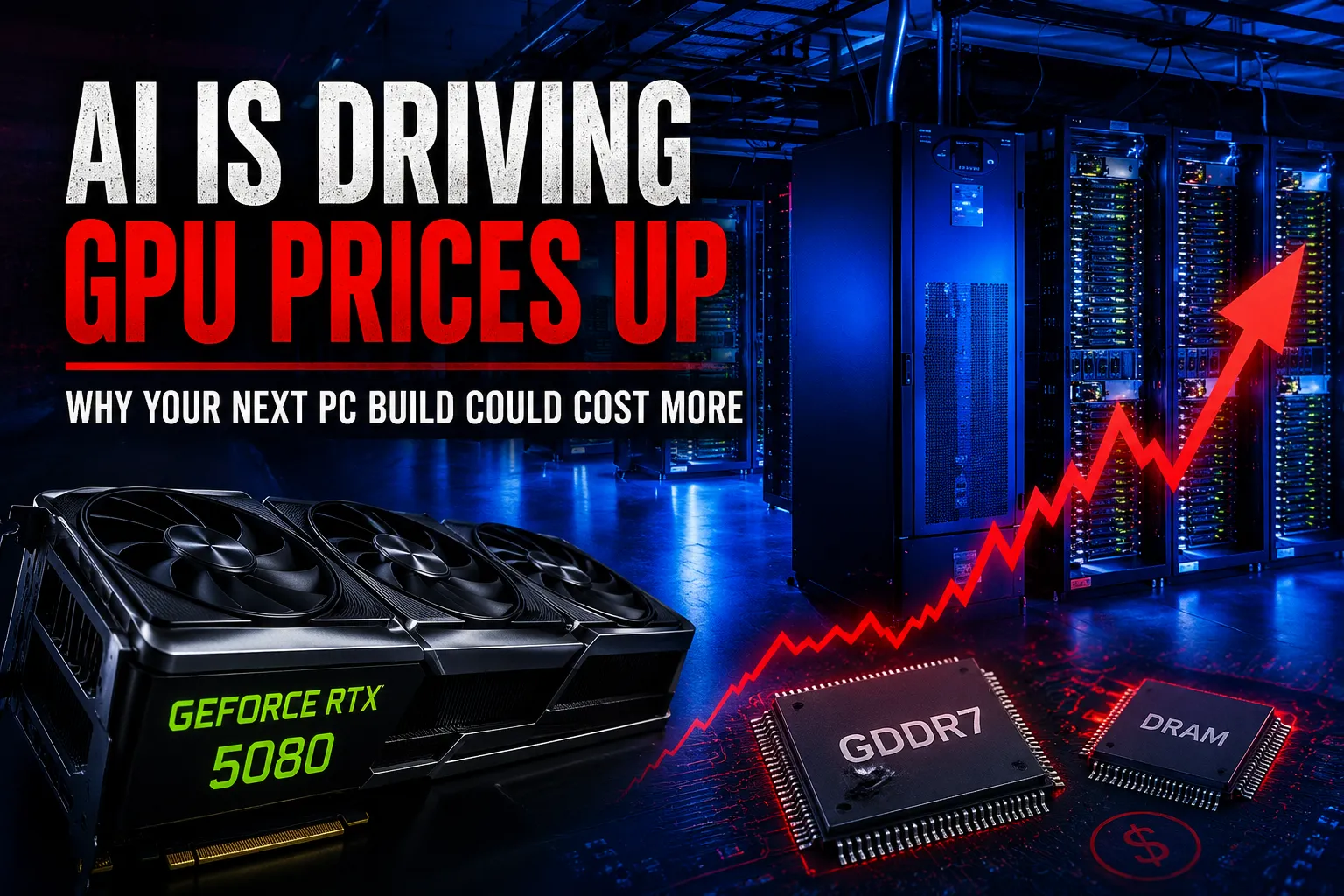
Every previous PC hardware price spike ended the same way. Crypto crashed, lockdowns lifted, supply caught up, prices fell. If you waited long enough, you won.
This one is different, and the difference is not sentiment — it is arithmetic. The memory industry has not run short of capacity. It has decided that selling memory to you is a worse business than selling it to an AI data centre, and the gap between those two businesses is wide enough that waiting will not close it.
The number that explains everything
A single HBM3E module — the stacked memory that feeds AI accelerators — sells for roughly $60 to $100. A comparable quantity of conventional DDR5, the kind that goes in your PC, sells for about $5 to $10.
Then the second number, which is the one people miss: producing HBM for AI accelerators consumes roughly three times the wafer capacity per gigabyte of standard DRAM.
Put those together and the manufacturer's decision makes itself. The same silicon wafer can become a product that sells for ten times more, and the fact that it yields fewer gigabytes barely dents the maths. No fab operator facing that spread voluntarily allocates capacity to consumer DIMMs.
This is why Samsung, SK Hynix and Micron have shifted more than 80% of advanced capacity to HBM and server DRAM. SK Hynix told investors its HBM, DRAM and NAND capacity was essentially sold out for 2026. Micron stepped back from consumer memory to concentrate on enterprise and AI customers.
Samsung has been warning publicly that the resulting shortages would drive an industry-wide price surge through 2026 — not a forecast from an outside analyst, but from one of the three companies doing the reallocating.
Nobody is hoarding. The product simply went somewhere more profitable.
What it has done to prices
The contract market moved violently. Industry trackers put conventional DRAM contract prices up roughly 90% quarter-over-quarter in Q1 2026, and TrendForce projected a further 58% to 63% increase in Q2, driven by AI server demand for high-capacity RDIMMs and cloud providers locking in long-term agreements.
Read that carefully: not 90% year-over-year. Ninety percent in a single quarter, then another 58–63% in the next one.
The same TrendForce note contains the detail that matters most for anyone building a PC — suppliers are reducing shipments to PC OEMs to serve the server segment, forcing PC customers to buy at higher prices. Consumer memory is not merely expensive. It is being actively deprioritised at the source.
What it costs you specifically
IDC's analysis translates this into consumer terms, and the projections are sobering without being hysterical.
For 2026, IDC expects DRAM supply growth of 16% year-on-year and NAND 17% — both below historical norms, in a year when demand is anything but normal. The knock-on effects:
- PC average selling prices up 4–6% in the moderate scenario, 6–8% in the pessimistic one
- PC shipments contracting 4.9% moderately, or 8.9% at the pessimistic end
An entire market shrinking by up to 8.9% because the components got too expensive is not a normal hardware cycle. It is demand destruction — people deciding not to buy at all.
And it reaches past RAM. Graphics cards need GDDR7 from the same fabs, which is why NVIDIA's planned Super refresh, built entirely around denser 3GB GDDR7 modules, never made it to desktops while the laptop version shipped. Consoles, phones and SSDs draw on the same pool.
Why "wait for it to blow over" is the wrong instinct
IDC's framing is the important part, and it is easy to skim past: this is a permanent reallocation rather than a cyclical shortage.
Previous spikes were demand shocks against fixed supply. Crypto miners wanted GPUs, then stopped wanting them, and the cards came back. Nothing structural changed.
This is a supply-side re-architecture. Manufacturers are rebuilding their product mix around a customer — AI infrastructure — whose demand is contracted years ahead and whose willingness to pay is an order of magnitude higher than yours. That customer does not evaporate when a token price falls.
The timeline confirms it. Relief depends on genuinely new capacity, and major SK Hynix expansion projects are targeting cleanrooms and volume output in 2028 to 2029. Fabs take years and billions; that schedule does not compress because gamers are unhappy.
Waiting for a correction assumes someone intends to correct it. On the current evidence, nobody does.
There is a modest counterweight: Tom's Hardware has reported the surge beginning to cool as consumers hit an affordability ceiling, even while AI demand keeps DRAM and NAND climbing through Q3 2026. That is real, but note what it describes — prices rising more slowly because buyers are refusing, not because supply returned. That is not relief. That is a market finding out what people will not pay.
How to actually handle it
The realistic moves, in rough order of usefulness:
Buy memory first, not last. The usual build advice — pick the CPU and GPU, fill in RAM at the end — is backwards in this market. RAM and storage are the volatile line items now. Price them first and build the rest around what is left.
Buy the capacity you need once. The old strategy of starting at 16GB and adding another kit later assumed prices drift downward. They are drifting the other way, and the matched kit you want may not exist at a sane price in twelve months. If 32GB is the target, buy 32GB now.
Weight VRAM more heavily than usual when choosing a GPU. Memory is the constrained resource across this whole generation, so it is the spec least likely to improve at a given price and the one most likely to decide how long the card stays usable.
Consider the previous generation seriously. Older platforms using DDR4 are not immune — DDR4 shortages and elevated prices are expected to persist through 2026, and manufacturers have been extending DDR4 lifecycles rather than expanding output — but a complete older system bought as a unit can sidestep the worst of the spot market.
Don't buy on a rumour of relief. Any headline promising the shortage is ending should be checked against one question: has anyone announced new consumer-facing capacity coming online before 2028? So far, no.
The uncomfortable summary
PC gaming spent two decades benefiting from being adjacent to a much larger business. Consumer DRAM was cheap because it rode the volume of an industry building memory at enormous scale for everyone.
AI is now that larger business, and it pays better. The component makers have noticed. The next few years of PC building will be shaped less by what GPU architectures can do than by what memory the people who make it are willing to sell you — and right now, the answer is: whatever the data centres do not want.
Tags: PCUpdates HardwareNews GPUPriceHikes RAMShortage RTX5080 RTX5070Ti RX9070XT GDDR7 AISupplyCrunch PCBuilding2026 TechInflation EnterpriseVsConsumer
Written by Shujaat Ahmed
Shujaat Ahmed is the founder and editor of Door To Gaming. A lifelong gamer, he writes about the games, hardware, and industry news he cannot stop thinking about.