The Ryzen 7 7700X3D Has the Same 96MB Cache as the 7800X3D, for $329
AMD shipped a Zen 4 processor in the middle of 2026, and it makes complete sense. The 3D V-Cache that drives X3D gaming performance is identical to the 7800X3D's — you give up 500MHz of boost clock and save real money in a year when everything else got expensive.
By Shujaat Ahmed · · 5 min read
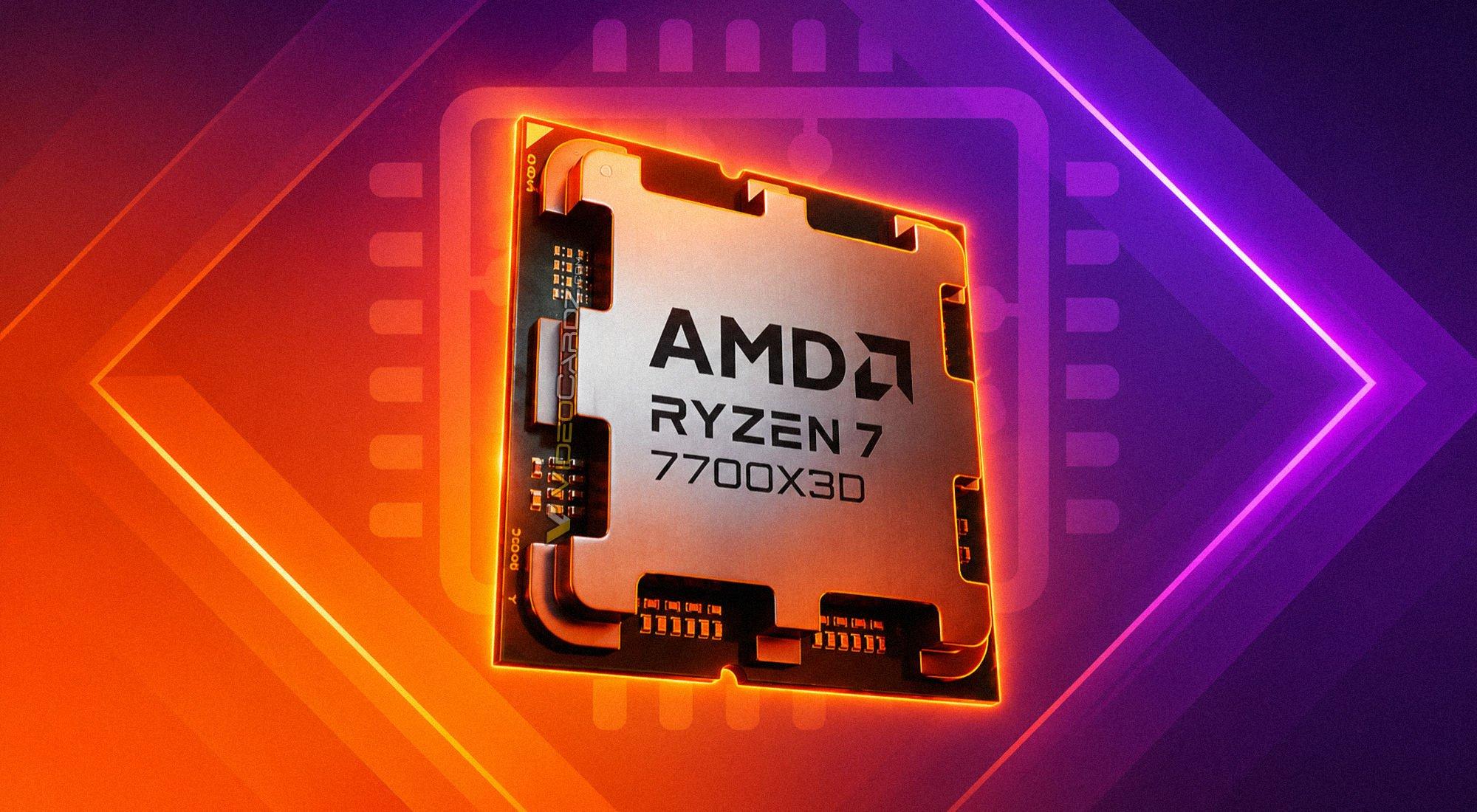
AMD launched the Ryzen 7 7700X3D on July 16, 2026, at $329. It is a Zen 4 processor — an architecture two generations behind AMD's current parts — arriving in the middle of 2026.
That sounds like a strange product. It is actually a precise response to what has gone wrong with PC building this year, and the spec that matters is one most coverage listed and moved past.
The cache is the whole product
The 7700X3D carries 96MB of L3 cache enabled by AMD's 3D V-Cache, out of 104MB total.
That is the same L3 figure as the Ryzen 7 7800X3D — the chip that has spent years as the default recommendation for gaming builds and has been either sold out or carrying punitive markups for much of that time.
This matters because 3D V-Cache's gaming advantage comes overwhelmingly from the cache itself. Games are latency-sensitive and branch-heavy; a very large L3 keeps working data close to the cores and avoids trips to main memory that cost hundreds of cycles. That single characteristic is why X3D parts outperform higher-clocked, higher-power CPUs in games while losing to them in rendering and compilation.
Give a cheaper chip the same cache and you have given it the same mechanism.
What you actually give up
The differences are clocks, and they are modest:
- Ryzen 7 7700X3D — 8 cores, 16 threads, 4.0 GHz base / 4.5 GHz boost, 120W TDP, $329
- Ryzen 7 7800X3D — 8 cores, 16 threads, 4.2 GHz base / 5.0 GHz boost
Same core count, same thread count, same L3. A 500MHz deficit at boost.
The consensus from early testing is what that spec sheet implies: the 7800X3D holds a small gaming lead on the strength of its clocks, and the 7700X3D delivers most of the same experience for less money.
"Most of the same experience" is doing real work in that sentence, and it is worth being precise. In GPU-limited scenarios — which is to say, most people playing modern games at 1440p or 4K — the gap will frequently be invisible, because the graphics card is the constraint. In CPU-limited scenarios, such as competitive shooters at 1080p on a high-refresh monitor, or simulation games with heavy CPU loads, the clock difference shows up.
Match the chip to how you actually play, not to a benchmark chart run at settings you will never use.
Why a Zen 4 chip in 2026 makes sense
The obvious objection is that Zen 4 is old. AMD has newer architectures. Why ship this now?
Because the binding constraint on PC building in 2026 is not CPU architecture. It is everything else.
Memory and storage prices have risen violently as manufacturers reallocate capacity toward AI data centres — conventional DRAM contract prices climbed roughly 90% in a single quarter, then another 58–63% in the next. IDC expects PC average selling prices up 4–8% and shipments down as much as 8.9%. Graphics cards are caught in the same squeeze, which is why NVIDIA's planned Super refresh, built around denser GDDR7, never reached desktops.
In that environment, a builder's problem is not finding the fastest CPU. It is assembling a complete machine at all without the total cost becoming absurd. A $329 processor that delivers near-flagship gaming performance, on the widely-supported AM5 platform, frees budget for the components that have actually inflated.
AMD did not ship a Zen 4 part in 2026 because it ran out of ideas. It shipped one because the market needed a cheaper entry to AM5, and it had a proven design sitting there capable of providing it.
Who this is for
Buy it if you are building a gaming PC on AM5 and want X3D performance without the 7800X3D's price or availability problems. This is the value play in the segment, and the cache parity is why.
Buy it if you are on an older AM4 system and moving platforms. You get a current socket with an upgrade path, at the cheapest X3D entry AMD has offered.
Skip it if you already own a 7800X3D or any newer X3D part. There is nothing here for you; the 7700X3D is positioned below what you have.
Skip it if your workload is productivity-first — rendering, compilation, heavy multithreaded work. X3D parts trade clocks and power headroom for cache, which is a great bargain for games and a poor one for throughput.
Think carefully if you play competitive titles at 1080p on a high-refresh display. That is the scenario where the 500MHz gap is most visible, and where paying more for the 7800X3D can be justified.
The timing is the point
There is a broader lesson in this launch about what "good value" means right now.
For most of the last decade, the advice for a gaming build was to buy the newest architecture you could afford, because performance per dollar improved reliably with each generation. That assumption depended on components getting cheaper over time.
They are not, and the parts that are inflating fastest — memory, storage, VRAM — are the ones where no clever purchasing decision helps. The CPU is one of the few places left where you can deliberately buy slightly older technology and lose almost nothing that matters for games.
The 7700X3D is that trade made explicit: a two-generation-old architecture, the current generation's most important gaming feature intact, at a price that leaves room in the budget for everything that has become expensive.
That is a more useful product in 2026 than a faster chip would have been.
Tags: PC Hardware AMD Ryzen 7 7700X3D 3D V-Cache AM5 CPU launch budget gaming PC gaming processor Newegg exclusive
Written by Shujaat Ahmed
Shujaat Ahmed is the founder and editor of Door To Gaming. A lifelong gamer, he writes about the games, hardware, and industry news he cannot stop thinking about.